Wednesday, 1 October 2014

The Thin White Dude's Reviews - Hector And The Search For Happiness


Directed by: Peter Chelsom

Produced by: Klaus Dohle
Trish Dolman
Christine Haebler
Phil Hunt
Compton Ross
Judy Tossell

Screenplay by: Peter Chelsom
Tinker Lindsay
Maria von Heland

Based on: Hector And The Search For Happiness by Francois Lelord

Starring: Simon Pegg
Rosamund Pike 
Toni Collette
Stellan Skarsgard
Jean Reno
Christopher Plummer
Barry Atsma

Music by: Dan Mangan
Jesse Zubot

Cinematography by: Kolja Brandt

Editing by: Claus Wehlisch

Studio(s): Egoli Tossell Film
Film Afrika Worldwide
Erfttal Film
German Federal Film Board
Screen Siren Pictures
Wild Bunch Germany

Distributed by: Koch Film

Release date(s): August 15, 2014 (United Kingdom)

September 19, 2014 (United States)

Running time: 120 minutes

Country: United Kingdom

Language: English

Production budget: $15.4 million

Box-office revenue (as of publication): $3, 206, 673


Aloha, this week I'm reporting from London, England, and because it's mostly a chill-out week I can't think of anything better to do than to visit round a bunch of the local art-house cinemas. That's one thing they certainly don't have a fond tradition of back home in Northern Ireland. As far as I know, there's the Queens Film Theatre and that's it really. I mean, I was shocked to find that when I exhibited The Act Of Killing earlier in the year I was, aside from the Queens Film Theatre and at a university seminar in Derry, the only person have actually shown the movie over there, which is a crying shame. Over here, it's like a haven for cineastes and with places like The Barbican (first time visit, truly incredible), you can see why people gravitate towards this city. There's something in it that sees to stimulate the imagination. Or, maybe that's just cultural displacement and my way of bemoaning the fact that Belfast is ten-fifteen years behind in every department and facet of life. Anywho, for all the latest and greatest in the movies, and the occasional blabber, keep your eyes posted!

Today's movie up for review is Hector And The Search For Happiness, the latest comedic venture for Simon Pegg. Pegg has had an up-down battle as far as his 'star' is concerned: he's in two major motion-picture franchises (as Benji Dunn is the Mission: Impossible series and Scotty in the rebooted Star Trek movies), and his work with Edgar Wright and Nick Frost can easily count as among some of the best comedy of the relatively new century, Shaun Of The Dead in particular standing out as a comedy classic, but his solo ventures have been a mixed bag, and even some of the better ones like How To Lose Friends And Alienate People have never quite reached the aspiration for greatness that I think is there is some of the projects he chooses, and no more is the case more apparent than here. This film is a dramedy, a mixture of both drama and comedy, the kind of which occasionally becomes small-fry Oscar-bait, something which is humorous and yet tries to tell us about all the important things in life etc etc. Plot synopsis goes that Hector (Simon Pegg) is a London-based psychiatrist, with a cushy lifestyle, thanks to the financial cover his job provides him, a devoted and attractive girlfriend Clara (Rosamund Pike), and yet he feels discontent with his routinised life, that there's something missing. And so, Hector decides to go on a globe-trotting adventure (which has been described somewhat dismissively by some in the press as "Eat Pray Love for men") in order to find out what makes people happy. Shall we dance?

(Yesterday I wrote all the positives for this movie but it appears that Blogger has once again failed to save it for me, so I'll try and muster some degree of enthusiasm for this one.)

Starting with the good, I thought that the character of Hector was relatively well-written, sympathetic even, and that Simon Pegg is most definitely the right person to play the part. We've always know him to be a capable comedic actor, able to play neurotic and socially awkward/uncomfortable people, so it isn't a great stretch, but it's hard not to acknowledge him, given that he does quite clearly give it his all, especially when it comes to the film's more dramatic scenes. The standout in terms of the supporting cast is definitely Stellan Skarsgard, who I thought did a fine job of playing a cranky business man. He's someone who is able to make a scowl or a furrowed brow say a thousand words, and when he does speak, going almost into soliloquies about how he came to be so thoroughly miserable, he's able to make it sound so engaging. Also, while the same cannot be said for much of the script, I thought that there were certain scenes and sequences that were written and directed rather well. For instance, the montage involving Hector listening to his various patients ad nausea, with the voices getting switched around and what have you is not only very funny but hammer the point regarding Hector's discontent at his life. Finally, as should be expected with a travelogue film that goes globetrotting around various different parts of the Earth and does a lot of soul-searching (blah, blah, blah!), it is a technically sound picture. The cinematography from Kolja Brandt is indeed picaresque and, despite the film's low budget, is a key element in suggesting the scope and getting across the film's central concept.

Now, as I mentioned there Blogger did not save my last paragraph, so I'm sure I probably wrote far more interesting things to say yesterday. However, going back over Hector And The Search For Happiness and my lack of enthusiasm as regards to reviewing the movie is indicative of the effect that the film had upon me. In the course of my writing about this film, I've been going back and forth between various Wikipedia articles (my Film Studies lecturers would be aghast at my using Wikipedia, but so fuck! I check all my sources, unlike some semi-professional critics, cough, Smithey, cough cough!), and every time I return to this film's Wikipedia entry, my brain almost does an inward sigh at the fact that yes, once again, I am going to have to continue to keep addressing movie. Yes, it's Hector And The Search For Happiness, with Simon Pegg smiling and dressed like a stereotypical travelling type, khakis and scarf and polaroid camera and bucket hat, yadda yadda yadda. And why do I have little enthusiasm for this film? I'll try and be as properly critical about this as possible, so we'll start with the script, which is just absolutely dire, really horrible. The film follows this almost episodic structure in terms of Hector going from place to place, finding out different potential solutions for his woes, and we are given these inane, bland and saccharine life lessons about what it means to be happy. At one point, Hector has a flight with a woman who has a brain tumour, and feels wonderful convincing the pilot to fly at a lower altitude, and this is meant to be one of the great heart-rending scenes of the film, as she is visiting her sister to more or less say goodbye, and it's done with such a mawkishly pious sense of self-importance that I couldn't buy any or it, dialogue, plausibility, anything. Also, when the film looks to be suggesting something potentially challenging or interesting such as polygamy, when Hector goes head over heels for a Chinese student, it back-pedals and pulls out of it (the sexual politics of this sequences is staggering. I initially wrote this sequence in as a positive, but in reflection it's more negative). The beautiful Chinese student isn't a student, she's a prostitute who the horrible businessman hired to service Hector and because he was drunk it's okay and therefore did not technically cheat on his girlfriend. Speaking of girlfriend, perfectly capable actors like Rosamund Pike, Jean Reno, Toni Collette and especially Christopher Plummer, who gets the dubious honour of playing the guru of Happiness Studies at UCLA, get saddled with lacklustre characters. At least Pike and Reno get to ham it up a bit, Plummer, even though he's meant to be an eighty-year-old man-child, is the wise old man who's meant to be serious and explain everything basil expository to the audience. I would say probably negative things about the music, but frankly I can't remember any music worth talking about. Finally, the last big problem of the film was combination of directorial and editing problems. A film like this has no business being over a hundred minutes, and yet for near two hours I sat there going "what am I doing here?" Claus Wehlisch's editing ensures that everything is dragged out to the nth degree, but at the end of the day he's only doing the job. Director Peter Chelsom really should have been aware just how much his movie was dragging it's fists along the ground, I would say like a gorilla, but that would be a disservice to the innate intelligence of primates, an intelligence and cop on, as they say in Mayo, which this film greatly lacks.

Originally, my feelings about Hector And The Search For Happiness were more positive than this, and even still I can find a number of things that I did like about. I thought that Simon Pegg and Stellan Skarsgard both delivered good performances, there were a couple of sequences, such as the therapy montage, whose humour indicated at a way savvier picture, and it is a very well-shot movie, appropriate for something of this travelogue nature. However, it is a movie that surrounds itself in the worst kind of mawkish sentimentality. Everything in the script that is potentially provocative, challenging and interesting being stamped out by stupid middle of the road, politically correct conclusions about how we should be living our lives. None of this does a service to us or the calibre of actors involved, and it has no right being two hours long, which, although the editing isn't as fine as it should be, is ultimately down to director Peter Chelsom not having enough sense to realise that his movie was dragging on and boring the tits out of the audience. There's more happiness in Morrissey's life of moaning about ghastliness and being "the son and heir of a shyness that is criminally vulgar." 

The Thin White Dude's Prognosis - 3.7/10

The Thin White Dude's Self-Diagnosis - Back (in action, not in black. Speaking of Back In Black, my sympathies are with the family of AC/DC's Malcolm Young)


Friday, 19 September 2014

The Thin White Dude's Reviews - The Purge: Anarchy


Directed by: James DeMonaco

Produced by: James Blum
Andrew Form
Bradley Fuller
Sebastien Lemercier
Michael Bay

Screenplay by: James DeMonaco

Starring: Frank Grillo
Carmen Ejogo
Zach Gilford
Kiele Sanchez
Michael K. Williams
Zoe Soul

Music by: Nathan Whitehead

Cinematography by: Jacques Jouffret

Editing by: Todd E. Miller

Studio(s): Blumhouse Productions
Platinum Dunes

Distributed by: Universal Pictures

Release date(s): July 18, 2014 (United States)
July 25, 2014 (United Kingdom)

Running time: 103 minutes

Country: United States

Language: English

Production budget: $9 million

Box-office revenue (as of publication): $106, 624, 724


Excursions, excursions, excursions, that's all there seems to be, alongside the many excuses piling up as regards to my slow rate of productivity for this year on the blog. Truthfully, as I've said before, I've had a wild busy few months over the summer at work which has continued on into September when I'm not on holiday. Speaking of which, I spent last weekend three nights in the wonderful town of Carcassone in the South of France. It's not exactly one of these places like Paris or Nice with the hustle and bustle of a booming nightlife, however, if you want a pleasant, relaxing time to enjoy a vacation (a well-needed one in my case, to paraphrase Arnie), by all means I'd thoroughly recommend it. It's not costly, the scenery, architecture and landscape is gorgeous and it has a serene atmosphere. Now, on movie matters, along with this, I've guaranteed reviews for Hector And The Search For Happiness, The Expendables 3 and Lucy on the back-burner, and no doubt I'll see more before the month closes, so, for all the latest and greatest regarding the movies, keep your eyes posted!

Today's film up for review is The Purge: Anarchy, the sequel to last year's The Purge, which despite being highly profitable was met negatively by critics. I myself had mixed feelings about the picture, but thought it a decent horror flick that had a terrific central concept going for it, which does bring up some interesting moral quandaries, was well-shot by cinematographer Jacques Jouffret (who, along with writer-director James DeMonaco, returns for this instalment) and boasted a great lead performance from Ethan Hawke. Unlike the first film, which was essentially a home-invasion movie, this time the premise has been changed up a bit: it is March 21, 2023, hours before the annual Purge, where for twelve hours (19.00-to-07.00) all crime is declared legal and emergency services cease to operate, an event which been declared responsible for the reduction of crime due it's cathartic impact on citizens, but instead it rather is a form of human population control, with certain weapons (explosives and destructive devices) declared exempt, as are government officials holding rank 10 or higher. Eva Sanchez (Carmen Ejogo), a waitress, rushes home to her daughter Cali (Zoe Soul) and father Papa Rico (John Beasley) to lockdown for The Purge. However, Rico slips out, leaving a note that reads how he sold himself to a rich family for $100,000 to kill, to be transferred to Eve and Cali's bank accounts following Purge night. A couple, Shane (Zach Gilford) and Liz (Kiele Sanchez) are driving to his sister's house to wait out The Purge. When their car runs out of gas, the are forced to fend for themselves on the streets. At the same time, police Sergeant Leo Barnes (Frank Grill) kits up to participate in The Purge and get revenge on the man who killed his son while driving under the influence. Early into the film, during paramilitary storming on Eve's apartment, when they attempt to kidnap her and her daughter, Leo drives by and ambushes them. Taking them to his armoured car for safety the three make a getaway with Shane and Liz, who have stowed away in the back seat during the shooting, and so all three points have converged and we have a party to try and survive the night, blah blah blah, blah, blah, blah...

So, overly-convoluted and wordy plot synopsis out of the way, let's get down to business! Starting with the good here, what they do in terms of moving the Purge concept on as a base idea is good. I've always been of the opinion that even though there have been mixed results, the concept itself is a terrific  starting point and premise for a horror film. There's so much that can be done with this idea, and I think that this is half the battle in terms of getting people initially interested to see where your picture goes. Also, to take it from the home-invasion genre and cast the net out into the streets is the natural progression for your film to go, so instead of repeating the same old story there's automatically something fresh being done here. Much of the same crew of the first Purge film is brought over into the sequel, and I think that it aesthetically benefits from their familiarity with the material. Cinematographer Jacques Jouffret, in a completely different setting to the first film, shows once again that he knows just how to light the picture in terms of creating the tone and the atmosphere. From a visual standpoint, this presents a wholly different challenge to the cinematographer, and he was more than up to the task. Finally, certain things that writer-director brings to the table in terms of the script and his direction were noteworthy in the positive sense. For instance, the Papa Rico subplot emphasises the class-war politics that the film is attempting to get across, as does a bidding war bordering on farce and satire over which rich Purgers gets to kill which kidnapped party within the safe confines of a warehouse. Also, there are a couple of standout action sequences, such as the warehouse shootout and a car chase in an underground tunnel, which are well-executed and clearly wouldn't have been possible within the confines of the house which was the setting of the previous film. The Purge: Anarchy, faults and all, does his some praiseworthy attributes.

However, as I perhaps indicated with that last sentence there, the film does have faults, and a good few of them at that. The first being that while the central premise is ingenious, DeMonaco and co don't have a storyline to hold up the film beyond that base point. Even though there are actors such as Frank Grillo and Michael K. Williams (who, me and my mate over Danland Movies, reminded us a lot Spike Lee, and not in a good way!) who try their earnest, I saw no reason to care about any of these characters as they were not so much as underwritten as just bog-standard stock types that we have seen in any number of movies beforehand. So, not caring about characters, that's number one. Number two, the journey they take these characters on is wholly unconvincing. When the different 'characters' converge and meet together, after their car dies, they all head on foot to the apartment of a colleague of Eva's to get a car: someone tell me how in the midst of all this wanton destruction, where people can get away with rape, murder, arson and all manner of crimes, why can't they steal a friggin' car instead of traipsing on foot to the other side of town? Also, someone who has seen this movie tell me they didn't see a big payoff involving the Revolutionaries, who are hinted at throughout the movie (which, let's not forget, has the subtitle 'Anarchy!'), roughly about a thousand miles away, who themselves are cardboard cutout beret-wearing peons, a shoddy attempt at politicising what is full all intents and purposes an exploitation horror film. Other aspects of the production were also troublesome. I mentioned about series returnees, and composer Nathan Whitehead, whose work on the first film was loathsome, brings more or less the same score, even though it sounds slightly different, to this sequel. I don't what it is, but why do people deem it necessary to inform us how we should feeling at any given stage during a movie? We are meant to be guided on an aural journey through a composer's work, not pushed and shoved in one direction and then jostled back into another. It's an outrageously generic horror movie score that has no place tainted the slowly decaying frequencies that my ears register. Finally, I felt that Todd E. Miller's editing required a combination of different things to be rectified; he needs to show a bit more tact when it comes to editing faster-paced scenes and not be like Michael Myers with a kitchen knife in an editing suite, and to not compose his montages in such an editorially cliched manner i.e. Pin drops, cut to all characters looking taken aback, smoke comes in, cut back to characters, back to smoke, in comes Revolutionaries, blah blah blah, blah, blah, blah...

If I sound like I'm bored at rattling on, well, that's because I am. There are things good about The Purge: Anarchy, such as the casting of the net outside of the confines of the film's original home-invasion set location, the cinematography by Jacques Jouffet, which is again atmospherically appropriate to the film, and some of the sequences and ideas conveyed by James DeMonaco through the central concept hint at what everyone involved is trying to get at. However, like the original, the execution suggests at unfulfilled possibilities, the fact that this could have been a way more thought-provoking and intelligent piece of horror cinema. None of the characters are engaging, and numerous parts of the exposition are nigh-on impossible to buy as plausible. Nathan Whitehead's score is outrageously generic (EMO, hello?) and Todd E. Miller's flawed editing don't help matters either. While I can't say that The Purge: Anarchy is a bad movie, it is deeply problematic and contrary to most of the critical notice going round, I found it to marginally worse than the original, which at least was halfway-decent. 

The Thin White Dude's Prognosis - 4.7/10

The Thin White Dude's Self-Diagnosis - Pensive (I've listened to Pink Floyd's Wish You Were Here about three or four times over the past week or so: I think that's my subconscious trying to tell me something!)


Thursday, 18 September 2014

The Thin White Dude's Twelve Most Personally Influential Films


Thanks to Daniel Kelly for nominating me on this one!

It's meant to be a list of the Ten films which had an impact at me at some point in my life and have went to influence me aesthetically from an artistic standpoint, but me being me I had to settle for a dirty dozen. I need to seriously do a Top 100 at some point, and by no means are these films ranked in terms of quality, but they deserve their spot, so, without further ado, I give to you:


The Thin White Dude's Twelve Most Personally Influential Films!


Battleship Potemkin (Sergei Eisenstein, 1925) - I saw this in my early teens, and was blown away by the use of montage and master storytelling. A couple of years ago, I went to an accompanied screening of this in the Ulster Hall by Martin Baker and a family went to see it, undoubtedly parents wanting to involve their children in something cultural: they all left after the Odessa Steps sequence, because the little ones were in tears. The film still has the power to shock!

The Seventh Seal (Ingmar Bergman, 1957) - At fifteen, this was my personal introduction to an artist who I consider to be one of my masters, the late great Ingmar Bergman. The Seventh Seal is an encapsulation of everything Bergman is about: intelligent, thought-provoking cinema of enrichment, with dense thematic content in sound and vision, all the while attaining profundity at cost-efficient, modest budgets.

The Good, the Bad and the Ugly (Sergio Leone, 1966) - At three hours long, the lengthiest film on this list, but with such immaculate pacing, the time flies in! Everything is done with panache, style and a sense of humour, the interplay between the three leads (Eastwood, Van Cleef and Wallach) wisely played. The cinematography, screenplay, editing, the wonderful score by Ennio Morricone, and of course Leone, this is one of those jigsaw puzzles where it all fits in snugly together.

Night of the Living Dead (George A. Romero, 1968) - A full year before Easy Rider put independent filmmaking on the map and five years before it's immediate descendent, Tobe Hooper's The Texas Chainsaw Massacre, George A. Romero heralded in a new dawn of horror filmmaking with his debut feature in 1968. What made Night of the Living Dead so influential, on both me and others, was two things: firstly, the realism, necessitated by the low-budget, was and is still shocking to behold, and secondly, that the zombie film genre, which exploded soon after, could be used to display horror filmmaking as a viable means for social commentary.

A Clockwork Orange (Stanley Kubrick, 1971) - Seeing this as a teenager was a revelation. It brought to mind so many questions: how did Malcolm McDowell make Alex, surely one of cinema's most morally corrupt and contemptible protagonists, so damn likeable? What sociological, psychological, political and philosophical implications does the work have? And how did Stanley Kubrick make such a hypnotically powerful and watchable film? It borders on postmodern just how compulsively watchable this violent film, which itself is a commentary on the nature of violence, truly is.

Aguirre, the Wrath of God (Werner Herzog, 1972) - Another one of my endeavours into the abyss as a fledgling cineaste, this film by Werner Herzog, another of my masters, continues to have a profound effect on me. It's very existence, the true definition of 'guerilla filmmaking,' is a triumph, as we trudge through the jungle with Spanish conquistadores into the dark, haunted soul of humanity. Through the mastery of film, we experience their delusions and hallucinations through Popol Vuh's score and Thomas Mauch's imagery, as they descend into barbarism and madness, fronted by a monolithic lead performance from Klaus Kinski. Spellbinding.

The Terminator (James Cameron, 1984) - Granted, I'm biased because it is in my not-so-humble opinion the greatest film of all time, but The Terminator to me represents the ultimate mastery of the medium of cinema. An extraordinary neon-lit nightmare, I saw this and it's superb sequel Terminator 2: Judgment Day at way too young an age (the latter of which, at age three or four, remains my first memory of the movies) and to this day, I still find myself blown away. For years, I though A Clockwork Orange was my favourite film, but as I got into my twenties, I realised that this movie, which has stayed with me through the years, was the one all along. I wouldn't be surprised if it's in the triple figures the amount of times I've seen it, and it just never gets old.

Robocop (Paul Verhoeven, 1987) - And the second of my eighties science-fiction films featuring cyborgs (maybe there's a recurring theme here, no?)... In all seriousness though, I saw this as a kid, and was always taken aback yet thrilled by the action and outrageously OTT violence, but now, as an adult, I see that my younger self would be in tune to my later aesthetic tastes. Robocop is classic genre fiction, using science-fiction as metaphor, touching upon the likes of capitalism, consumerism, identity, religion (Robocop's widely seen as a Christ-like Messianic figure), all making up what I feel is the best movie about America in the 1980s.

Withnail & I (Bruce Robinson, 1987) - One of the reasons I love Withnail & I (notwithstanding the many other reasons!) is because growing up I really identified with the titular characters: I have known people like that, I have been on the odd venture or two not unlike but nowhere near as wild as their trip to the country is. However, underneath all the hilarity and drunken debauchery, there is most importantly a pulse, a heartbeat that tunes in to the kindred spirit of all of those dreamers who have wanted to escape their confines and make something themselves. A farcical, yet poignant tour-de-force.

AKIRA (Katsuhiro Otomo, 1988) - Despite murmurings of live-action remakes for many years, I frankly see it as an impossibility to make something as breathtaking as Katushiro Otomo's 1988 adaptation of his own manga. Before AKIRA, my experience with animation had been through Disney, Pixar and the works, all children's animation, so not only was introduced to the world of anime (and subsequently manga) but also truly adult animation. It's an oft-repeated inside joke that you have to AKIRA seven or eight times in order to start to get it, and while I think that's a slight exaggeration, it gets the point across, because the ways you can look at this film are near infinitesimal. I don't anyone who comes out of it will describe it the same way as their fellow filmgoers.

Elephant (Alan Clarke, 1989) - Biased pick again, yes, but hey, it's my list. Alan Clarke's film about the Troubles is the single most important film about Northern Ireland, hands down. I saw this during a Film Studies seminar and frankly, although it was followed by Gus Van Sant's film of the same name (a tough double-bill if ever there was one), the overall experience was clouded by the atmosphere of Clarke's film, which is utterly shocking and extremely upset. It's the truthful honesty with which the subject is addressed that got to me, and Clarke's aesthetics in his overall filmography have since become a big influence on my own work.

Oldboy (Park Chan-wook, 2003) - The final and most recent film on this informal list is Park Chan-wook's masterful thriller. The set-up is simple, a man is kidnapped, imprisoned for fifteen years, released and given five days to discover who kidnapped him... or so it seems. This rich and complex spiders-web is unveiled with such elegance and style that it's any wonder I feel head over heels for it as a teenager. Furthermore, it has something to say about morality and the psychological impact the movie has will stay with you, as it has with me, for many years to come.

Well, there you have it. While this is an informal list that does not necessarily represent my favourite movies of all time or is ranked in any specific order shape or form, they are all, in my opinion, great films that I feel worthy enough of your time to watch. Give me your thoughts and opinions regarding the list, and what you films you feel are a big personal influence for yourselves.


Tuesday, 9 September 2014

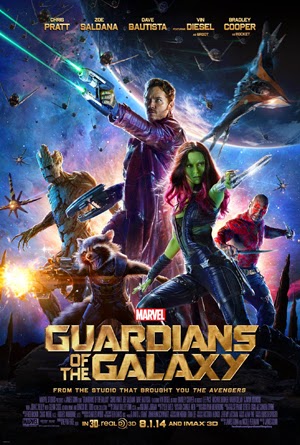
The Thin White Dude's Reviews - Guardians Of The Galaxy


Directed by: James Gunn

Produced by: Kevin Feige

Screenplay by: James Gunn
Nicole Perlman

Based on: Guardians Of The Galaxy by Dan Abnett
Andy Lanning

Starring: Chris Pratt
Zoe Saldana
Dave Bautista
Vin Diesel
Bradley Cooper/Sean Gunn
Lee Pace
Michael Rooker
Karen Gillan
Djimon Hounsou
John C. Reilly
Glenn Close
Benicio del Toro

Music by: Tyler Bates

Cinematography by: Ben Davis

Editing by: Craig Wood
Fred Raskin
Hughes Winborne

Studio: Marvel Studios

Distributed by: Walt Disney Studios Motion Pictures

Release date(s): July 31, 2014 (United Kingdom)
August 1, 2014 (United States)

Running time: 122 minutes

Country: United States

Language: English

Production budget: $170 million

Box-office revenue (as of publication): $586, 365, 199


What a shock, things didn't go according to plan, eh? Basically, I had a work schedule all sorted out, but then, through a bit of fault of my own in light of hitherto un-forseen circumstances, I ended up adding more work onto my already substantial load, and all in all, I did a total of one hundred and eleven hours over ten days. The only day I had off during that period was travelling to Stradbally to work Electric Picnic, so believe me when I tell you I had no time to watch any movies. However, no that I'm back and I've already got started again, I've decided to compile both August and September together and address the monthly review at the end of September with the both of them. I've a lot more time on my hands to devote myself to my film reviewing and various artistic endeavours (and hey, maybe I'll actually go and get myself a social life again at some point!), so, for all the latest and greatest on the movies, keep your eyes posted!

Today's film up for review is the much-anticipated latest release from Marvel Studios, Guardians Of The Galaxy. It's intelligent marketing campaign, which offered itself up as something wholly different to what we have seen come out of the Marvel brand, which has since 2008's Iron Man been primarily focused on the characters that comprise The Avengers. As such, with the Guardians being a lesser-known property outside of the comic world and James Gunn at the helm, a director who, while bringing a unique quality and offbeat humour with him, had no box-office successes to his name in that capacity (he wrote Tromeo & Juliet, the live-action Scooby Doo features and Zack Snyder's Dawn Of The Dead, but his two directorial productions, 2006's wholly underrated and outrageous Slither, and 2010's Super, were for all intents and purposes flops), this was a bit of a gamble for Marvel to see if there was any interest in their universe outside of the Iron Man's, Thor's and the Captain America's. Okay, so, plot synopsis goes that in 1988, after his mother's death, Peter Quill is abducted from Earth by the Ravagers, a group of space pirates led by Yondu Udonta (Michael Rooker). Twenty-six years later, Quill (Chris Pratt) steals an orb and after being intercepted by Korath (Djimon Hounsou), he escapes with it. On the hunt for the orb though is Ronan (Lee Pace), who is attempting to capture the orb for Thanos, and sends the assassin Gamora (Zoe Saldana) after the orb. However, two bounty hunters, Rocket (Bradley Cooper) and Groot (Vin Diesel) are drawn into the fight, and the four are arrested by the Nova Corps and imprisoned in the Kyln. While in the Kyln, a powerful inmate by the name of Drax (Dave Bautista) attempts to kill Gamora due to her association with Ronan, who murdered his family. Drax is dissuaded by Quill, who offers the incentive that Gamora can take him to Ronan, and after escaping the Kyln, the five form an uneasy alliance to help each other succeed in their various goals. Capiche? Good!

To start off with the good, the central ensemble that comprise the Guardians are terrific. Chris Pratt, who underwent an intense dieting and workout regimen to lose weight for the film, anchors the movie in the part of Peter Quill. His comedic talents and awareness of the character's fallibilities mean that Quill has an interesting arc: at the beginning, the Star-Lord figures himself a bit of a Han Solo character, but really is a brilliant yet arrogant buffoon, and Pratt subtly manages to make the smooth transition into what Quill is later to become. The combination of the physicality he brings to the film and the his well-worked comedic persona, which lends him a strong sense of timing when it comes to the dialogue, make this a fine lead performance. Also good are Zoe Saldana, who brings real strength to the part of Gamora, and Vin Diesel as Groot, providing the film a sympathetic and humorous motion-capture performance with his innumerable variations of the line "I am Groot." I'm not trying to skimp on those two, but I want to focus on other performances specifically. In his debut lead role as Drax the Destroyer, Dave Bautista, who has always been a strong physical presence since his WWE days, finds himself an acquired knack for deadpan comedy. Bautista's ultra-serious physical specimen, who is so single-minded on his quest for vengeance, is juxtaposed with some great dialogue regarding his lack of awareness on his being the butt of many jokes. Lines like "nothing goes over my head! My reflexes are too fast, I would catch it" ensure that, thanks to Bautista delivery, Drax, though not being the 'funny guy,' gets some of the best gags in the film. Bradley Cooper too delivers a fine performance in the part of Rocket. Although Sean Gunn (who stood in for Cooper on-set during filming) deserves credit, I think the vocal performance from Cooper is of a consistently high standard. Vocally, there's something of the fast-talking New York/Jersey gangsters from Martin Scorsese's movies and The Sopranos about Rocket. Also, what's interesting about this is how smoothly Cooper is able to transition from playing it funny to being really very serious and surprisingly poignant depending on the tonal direction the film is moving towards. Finally, outside of the central Guardians, there are two strong performances from the supporting cast. Admittedly I'm biased here, because I've made my admiration for him known in the past, but I thought Michael Rooker was great Yondu. Always a dedicated actor, the case is the same here, for he fully throws himself into this part, bringing to the part a manic energy and a palpable tension, not just in his lines but in the wild-eyed, predatory smiles, that Yondu could snap into violence at the drop of a hat. Also, in his short scene, Benicio del Toro (who looks an awful lot like Jim Jarmusch here) is highly entertaining as The Collector. So, cast done, lets get to the other parts that were good about Guardians Of The Galaxy. Excusing the horrible pun, but from a technical standpoint the film is indeed a marvel. Ben Davis' cinematography has a distinctively clean look, which is a pleasure to behold amidst the glut of summer blockbusters whose work on digital has a ruddy, murky textural palette. Here, the film is lit and shot in a manner not unlike that of a prismatic effect, the gorgeous visuals the product of the light refracted through the viewfinder. Speaking of visuals, the visual effects are also of a consistently high standard. Not only does it enhance the performances of Vin Diesel and Bradley Cooper/Sean Gunn, but outside of the performance capture it helps to realise in splendour the various worlds which the characters inhabit. The combination of digital/visual effects and practical/physical effects in Guardians Of The Galaxy are not dissimilar to the standard of mise-en-scene set by the original Star Wars films. As much as the film's cast, the list of names contributing to the overall design of the picture reads like a who's who, with Alexandra Byrne and David White, both of whom got their starts working under Kenneth Branagh, on costumes and special effects makeup design respectively, master sculptor Brian Muir, whose work includes Darth Vader and the Stormtroopers from Star Wars, the Ark of the Covenant in Raiders Of The Lost Ark and the Space Jockey from Alien, so this a film whose production is stacked with talented individuals plying their craft. Incidentally, the film has three editors (Craig Wood, Fred Raskin and Hughes Winborne), but despite this, the film is surprisingly consistent and doesn't pull in all different directions. Another aspect of the film which I found to be aesthetically interesting was the choice of music in the film's soundtrack. Intelligently, a plot point is made out of this (the tracks are all on a cassette in Quill's Walkman, which he aptly labels "Awesome Mix Vol. 1"), and as such we get songs from David Bowie, The Runaways, The Jackson 5 and Marvin Gaye woven into scenes throughout the film. Of course, the highlight is the use Blue Swede's Hooked On A Feeling, heavily used in the marketing, which becomes the film's equivalent of an anthem in terms what they're trying to get at tonally: it's a funky, slightly mad but most importantly fun track indicative of the film's ribaldry. A lot of that is down to (in my final point of positivity) writer-director James Gunn. As I mentioned in the preamble to my synopsis, to have a director like James Gunn, who although having a solid track record as an artist and unique filmmaker hasn't always went hand-in-hand with the box-office, was a gamble, but one I think Marvel wisely realised would pay off. Arguably, the thing that sets Guardians out from the rest of the Marvel cinematic canon is what Gunn brings to the table, in his genre film sensibilities, offbeat humour and an empathy for the outsider. The former welds a b-movie feel to the general atmosphere, the latter two ensure that while his characters are always funny, with Gunn's ear for sharp dialogue and witty banter coming to the fore here, they are also sympathetic, each with their own faults and defects making them who they are. As someone who has followed Gunn for many years, seeing his various ups and downs, it gives me no greater pleasure than to see how well Guardians has done at the box-office. After opening weekend, Gunn wrote a letter of thanks on Facebook, from which I'll take this extract: 

"Thanks to all of you who saw (and are seeing) 'Guardians Of The Galaxy' this weekend, from the bottom of my heart. The Guardians are a group of oddballs, outcasts, and geeks. The movie is for anyone who ever felt cast aside, left out, or different. It's for all of us who don't belong. This movie belongs to you. And, today, I think we're doing okay."

Those are not only the worlds of a grateful and humble man, but those of a filmmaker who completely gets what the material is about. In many ways, Guardians Of The Galaxy is a real triumph of creativity and a collective working together to do something special.

However (the big, damnable 'however...'), much as I liked Guardians Of The Galaxy and think that it is a highly watchable, highly admirable work, it doesn't quite etch itself out as a great film, and that is for a number of reasons. First and foremost, while I thought the dialogue and characters were terrific, the same cannot be said for the film's plot. I think these problems emerge not necessarily from Gunn or original screenwriter Nicole Perlman's work but rather from the recurrent problem that most films never escape as the first instalment of a potential franchise. Almost by default, they have to obey the same basic formulaic structures, so as to lay the groundwork and get down to the real business in future instalments. Guardians, sadly, is no different. Although the leads do the job well, the Guardians all go on the same journey of self-discovery we have seen many many times before in origin stories. The same can also be said for the plot, which is a simple case of point-A to point-B to point-C, connect the dots. It can kind of get away with it because it's done well, but not entirely! There are only three movies over the past ten years which have truly successfully done it: 2005's Batman Begins, 2006's Casino Royale and 2012's Dredd (the last being a sort of 'anti'-origin story. Not a franchise either, I know... yet!) Also, none of the primary villainous characters (Ronan, Nebula and Korath) convincingly written in as credible threats to the protagonists (especially with the shadow of Thanos looming over everything!). Also, when you have almost an assembly line of fine actors such as Glenn Close and John C. Reilly coming on board, surely even with their scant screen-time more could have been done to flesh them out. To a lesser extent, the same can be said for Tyler Bates' original score. While his work here has it's moments, it too follows the same basic principles of film scoring and doesn't really do all to much with them. Much as I liked Guardians, I consider it a necessary part of critiquing it to be down to fair judging and being able to look at it for how I see it, defects and all.

Well, despite my reservations regarding certain aspects of the script, which result in a formulaic and base murder-by-numbers point-A to point-B plot structure, the fact that while the Guardians are well-crafted, the antagonists and numerous supporting characters are not fleshed out enough to justify the quality of actors playing them, and to a lesser extent Tyler Bates' score, Guardians Of The Galaxy is still a very good, highly enjoyable film. The performance of the central cast playing the protagonists, most specifically Chris Pratt, Dave Bautista and Bradley Cooper/Sean Gunn, and a manic supporting part from Michael Rooker, are uniformly great, and this quality is also consistent with the film's technical aspects. Ben Davis' clean cinematography distinguishes itself from the drab visuals of many contemporary blockbusters, and the visual effects do much to bring the world(s) these characters inhabit to life. Also, from a design standpoint this movie has as much love and care going into it's craft as that of the original Star Wars pictures. The soundtrack too, interwoven into the picture, is used intelligently to indicate a certain tonal mood and feel to the the picture. Finally, James Gunn's major studio debut as a director is largely a triumph. He truly seems to understand the essence of what this project is all about so that, faults and all, we can still derive much enjoyment from Guardians Of The Galaxy.

The Thin White Dude's Prognosis - 7.8/10

The Thin White Dude's Self-Diagnosis - Chilling (by way of enjoying some much needed time off work!)


Tuesday, 19 August 2014

The Thin White Dude's Movie Of The Month: July 2014 - Dawn Of The Planet Of The Apes


Between this and Edge Of Tomorrow, it's been nice to have at least two summer blockbusters which deliver both the spectacle you'd expect from a big-budget picture, but also that they are of a high artistic quality. The harmony between the motion capture action (particularly Andy Serkis and Toby Kebbell) and the visual effects is breathtaking, with Weta Digital outdoing their amazing work in the previous film, truly bringing these apes to life. Their interactivity with the composites departments and Michael Seresin's cinematography deserve to be duly credited, as does Michael Giacchino's score, which legitimises the epic feeling of this franchise film. Design-wise, it's beautifully realised, a film of real provocative ideas and daring directions, with Matt Reeves delivering his best film to date. Aside from the 1968 original, it's the best film of the Apes saga. 

The Thin White Dude's Prognosis - 8.8/10


Runner-Up: Begin Again - Even with problems, John Carney's film has empathy and understanding for human emotions, displays an ear for dialogue and boasts strong performances from Keira Knightley and Mark Ruffalo.

Second-Most Deadly Disease: Transformers: Age Of Extinction - While there are things to admire, it's a $210 million movie with a horrible script full of cardboard cutout characters, cliches and expository nonsense which in conjunction with consistently inconsistent editing, make for a long expenditure of 165 minutes of your life.

Avoid Like The Plague: Tammy - With episodes of mish mash and balderdash, dulled underlying messages and a whole lot of other things I missed because the movie is too stupid to get it across appropriately, Tammy is not McCarthy's vehicle to set the world on fire.

The Thin White Dude's Reviews - Maleficent


Directed by: Robert Stromberg

Produced by: Joe Roth

Screenplay by: Linda Woolverton

Based on: Disney's Sleeping Beauty
La Belle Au Bois Dormant by Charles Perrault

Starring: Angelina Jolie
Sharlto Copley
Elle Fanning
Sam Riley
Imelda Staunton
Juno Temple
Lesley Manville

Music by: James Newton Howard

Cinematography by: Dean Semler

Editing by: Chris Lebenzon
Richard Pearson

Studio(s): Walt Disney Pictures
Roth Films

Distributed by: Walt Disney Studios Motion Pictures

Release date(s): May 28, 2014 (United Kingdom)
May 30, 2014 (United States)

Running time: 97 minutes

Country: United States

Language: English

Production budget: $180 million

Box-office revenue (as of publication): $743, 781, 750


So, this will be my last film to review for the month of July. I've already given y'all enough excuses and reasons as to why everything has been belated this summer. This will be followed by a review of the July, and hopefully I'll get one, maybe two more reviews done before Thursday, because I'm on the road again for V Festival and for the next few weeks. I've already got ahead and seen Guardians Of The Galaxy and The Purge: Anarchy, and hopefully I'll see a couple of more before I head away. As ever, for all the latest and greatest about the movies, keep your eyes posted!

Today's film up for review is Maleficent, Disney's live-action re-imagining of the story of Sleeping Beauty, made previously by Walt Disney in 1959 as animated feature, only for this 2014 adaptation the story is portrayed from the perspective of the titular antagonist. Angelia Jolie, who stars as the main character and is the name on the marquee, has been attached to this project for a number of years, as Tim Burton was originally planning to direct the picture. When he opted to leave, Robert Stromberg, the production designer for Burton's Alice In Wonderland, Avatar (for which Stromberg won with Rick Carter my Dante Ferretti Award for Best Production Design) and Oz, The Great And Powerful, was drafted in to helm. While I think her work outside acting is perhaps even more commendable than her film work, I've been a fan of Angelina Jolie for some time (she won Best Female Actor in a Leading Role from me in 2008 for Changeling) and feel she's one of the most interesting female actors of the past ten-fifteen years, so I was interested enough going into this. So, story goes that Maleficent (Jolie) is a faerie living in the Moors, a magical realm bordering a human kingdom, who has over the years developed a friendship with a human peasant called Stefan (Sharlto Copley). However, his ambition to become king overshadows their mutual affection, and when the current king is defeated in battle by those of the faerie kingdom, he offers to name whoever kills Maleficent the successor to his throne. Stefan burns off Maleficent's wings, offering them as evidence of her death, and ascends to the throne. A little while later, Maleficent, the once humble and benevolent faery who has since become a cruel, wicked witch, is informed by her servant Diaval (Sam Riley) that Stefan and his queen are christening their daughter Aurora. Gate-crashing the ceremony, Maleficent takes her revenge on Stefan out on Aurora, who is cursed prick her finger on a spindle wheel on her sixteenth birthday to fall into a death-like sleep, from which she can only be awakened by true love's kiss. Fifteen years later, Aurora (Elle Fanning) becomes enamoured with faery world and develops an acquaintance of sorts with Maleficent, who she believes to be her fairy godmother, unwitting of the true scheme at work. Blah blah blah. That's just expository setup, so excuse me for the mouthfuls! Got it? Good!

Starting with the good, the film has four solid performances, nothing groundbreaking by any means, but still enough positive work to give the film some anchoring. Angelina Jolie absolutely revels in the opportunity to play the fairy tale 'good girl gone bad' Maleficent. Beginning the film as an earthy creature, after the much-discussed (and legitimately harrowing) scene in which Stefan drugs her and takes her wings (which Jolie plays brilliantly), Jolie's Maleficent transforms into every bit the pantomime Disney villain as much as Glenn Close's Cruella de Vil. It's a very theatrical part, but it's never over the top, with Jolie's vocal line delivery being deliberate and authoritative. Also, her expressive features mean that when moments of humour come along, we start to see the facade of callousness break. Jolie deserves the praise she's received for this textured performance. We also have Sharlto Copley in there as Stefan, who, though occasionally hammy, is reminiscent of Gary Oldman in that he does manage to bring credibility to the part. Same can be said for Sam Riley (the inaugural winner of my Kevin Spacey Award for Best Male Actor in a Leading Role for 2007's Control), who has strong onscreen chemistry with Jolie as Maleficent's confident Diaval. Finally, Elle Fanning, though in a less complex role than we've seen her in the past, continues her rise as one of Hollywood's most promising young talents with her charismatically likeable Princess Aurora. One of the other things to be praised about the film is the overall look of the mise-en-scene. Perhaps this is to be expected with director Robert Stromberg's history in various aspects of design, but Maleficent does have a distinctive and unique look about it. The visual effects and production design of the faerie kingdom in various stages (after Maleficent's evolution, it changes from a wondrously cute land of cute things and what have you to the proverbial "hillside desolate" Morrissey would sing about in a long forgotten song; nudge nudge, wink wink!) is simply splendid, and the goes for many of the other sets and design aspects involved. Also, the make-up/hair department and costume designers deserve credit for their collective efforts in bringing these characters to life. With the greatest of respect to Jolie's natural abilities, they've done a terrific job in making her look every bit the part, with her cheekbones elevated, jawline sunken in and red lips standing out as a contrast to the paleface make-up, and the headpiece and long black dress just adding more and more character to, well, this character. All of this is accentuated by the cinematography of Dean Semler. From the Mad Max sequels, Oscar-winning work on Dances With Wolves and the likes of Mel Gibson's Apocalypto, Semler has a way of shooting unobtrusively in a way that the cinematographer and camera does not supersede but instead highlights and adds to the atmosphere made by the designers. The case is no different here; there's no gimmickry or shaky-cam buffoonery, just good old-fashioned photography. Finally, as far as directorial debuts go, Stromberg could do a lot worse than Maleficent. This is a good, enjoyable release from Disney, a welcome surprise and at just under one hundred minutes, it's a lot more immediately accessible than some of the more cumbersome releases of this blockbuster season. While Maleficent is not without issue, which I'll get to, it clearly hit home with its audience, and shows there is a market for this big-budget, Tim Burton-esque kind of picture when it's done well. Although judging by Burton's recent work, Stromberg has arguably out-Burtoned Burton, and needn't worry about having to establish himself outside of that director's looming dark shadow.

Now, as I said, Maleficent is not without issues, the issues laying in a few certain areas which, while not degrading the movie to the point that's of a bad quality, do deny it from being a great or a very good movie. The first thing at fault I found was the script. As you saw, there was a lot waffle to get through in my plot synopsis, and the same can be said for the movie, because it takes about thirty to forty minutes of screen-time to just establish the backstory. Realistically, all of the expository details there should have been done and dusted in ten to fifteen minutes, and the fact that it takes up approximately a third of the film's runtime does reveal a structural flaw. Secondly, although I was impressed with the characterisation of some of the principal's, many of the film's minor characters are simplistic tropes which just come across as filler. For instance, the three pixies are quite clearly just comic humour fodder, their existence merely serving to provide for stupid moments of levity amid the film's drama, and do not serve to do justice to Imelda Staunton, Lesley Manville or Juno Temple, three female actors talented enough to hold lead roles in their own right. Also, the Prince Philip character, who like Aurora we're meant to realise is 'the one' who's going to break Maleficent's curse upon her, is so bland that I refused to buy into him in any way, shape or form. On another point of issue, though rather more minor than the script, although I like James Newton Howard, this is one of those films scores that is just phoned-in without any active participation or providing elevation of the material. Maybe it was studio-imposed impositions (this is, after all, $180 million-budgeted picture), but I just didn't have the feelings of inspiration I have got from Newton Howard's work in, say, Pretty Woman, The Fugitive, Primal Fear or The Sixth Sense. My final issue was with the editing, which I do have to say feels a bit scattershot. The film's two editors Chris Lebenzon and Richard Pearson are associated mostly with working on action movies, not that that is a problem for the film's occasional action scenes, but the same aesthetics do not apply to conversations, dialogues and some of the more serene moments involving the film's design. I feel that the editors needed to show a little more tact when it came to the bigger picture.

I will not deny Maleficent is a movie with it's flaws, most specifically in the departments involving the script, the score and the editing. I do feel that these elements hold the movie down from achieving the status of being among the great Disney fantasies that it could have been. That said, neither will I deny that even with these flaws, it still stands as a good, perfectly acceptable watch. I think that Angelina Jolie is terrific in the title role, completely relishing playing the part of playing the cold-hearted villainess, but not without an element of pathos. Also strong in the principal cast are Sharlto Copley, Elle Fanning and Sam Riley. From a design standpoint, this is a well-realised picture, with director Robert Stromberg's background lending to the whole shebang. It's also shot by an atmospherically-intuned cinematographer in Dean Semler, whose work accentuates that of the designers and visual effects departments. At under one hundred minutes, this is a relatively brisk studio picture from Disney, and judging from the box-office (it has grossed over four times it's budget at $736 million worldwide), there have been some smart decisions in the archetypal boardroom meetings as regards to marketing and the film itself. Though by no means anything as special as the box-office figures would indicate, Maleficent is still a solid Disney fantasy with a terrific lead performance from Jolie and an enjoyably brisk flick.

The Thin White Dude's Prognosis - 6.4/10

The Thin White Dude's Self-Diagnosis - Racked (with many things to do! V Festival coming up this weekend and still work to be done. Argh!)


Friday, 8 August 2014

The Thin White Dude's Reviews - Dawn Of The Planet Of The Apes


Directed by: Matt Reeves

Produced by: Peter Chernin
Dylan Clark
Rick Jaffa
Amanda Silver

Screenplay by: Mark Bomback
Rick Jaffa
Amanda Silver

Based on: Characters created by
Rick Jaffa
Amanda Silver
Suggested by Planet Of The Apes by Pierre Boulle

Starring: Andy Serkis
Jason Clarke
Gary Oldman
Keri Russell
Toby Kebbell
Kodi Smit-McPhee

Music by: Michael Giacchino

Cinematography by: Michael Seresin

Editing by: William Hoy
Stan Salfas

Studio(s): Chernin Entertainment
TSG Entertainment

Distributed by: 20th Century Fox

Release date(s): July 11, 2014 (United States)
July 17, 2014 (United Kingdom)

Running time: 131 minutes

Country: United States

Language(s): English
American Sign Language

Production budget: $170 million

Box-office revenue (as of publication): $451, 633, 624


So, with things back in action, I'm going to keep the ball rolling on this bad boy. On an outside of topic note, currently New Japan Pro Wrestling's annual G1 Climax tournament is going on, and I'd urge anyway who's into wrestling in any shape or form to follow it, because frankly, much as I like WWE's product, I've been more interested in NJPW's output of late. With that being said, this is a movie blog, so, bringing out the usual mantra (drumroll, please!), for all the latest and greatest in the movies, keep your eyes posted!

Today's movie up for review is Dawn Of The Planet Of The Apes, the eight film in 20th Century Fox's Planet Of The Apes franchise and sequel to 2011's reboot Rise Of The Planet Of The Apes. Like the Transformers franchise, I have a bit of history with that of the Planet Of The Apes, albeit on far more positive notes than the former. The original film from 1968, based on Pierre Boulle's novel of the same name, is a bona-fide science-fiction classic, a startling depiction of a world turned upside down which, like George A. Romero's Night Of The Living Dead, released the same year, used the genre film format for allegorical means to challenge prevalent ongoing societal issues. The tone is much the same for the film's four sequels, with varying results and quality. Beneath is a very strange and bizarre film which, though decent, doesn't quite nail it the same way the original did, while Escape is a lot more satirical in form, transplanting Zira, Cornelius and Dr. Milo to present day Los Angeles. The sequels hit their darkest and highest point with Conquest, a truly nightmarishly dystopian vision of racial conflict and slavery, but finished on a bum note with Battle, the only film in the series which is truly flat and uninspired. Toys, television series, and twenty-eight years later, Tim Burton's Planet Of The Apes hit the big screens, and while making no dent on the original film, is admirable in it's own way and a whole lot better than people care to remember. Ten years and a lot of technological advances in the film industry later, another film came round in the guise of Rupert Wyatt's Rise Of The Planet Of The Apes. Now, I was the first to start groaning about motion capture and visual effects replacing the traditional make-up designs originated by John Chambers which were such a key part to the series. However, Weta Digital done a terrific job, accentuating the powerful central performance by Andy Serkis (for which he won in 2011 my Kevin Space Award for Best Male Actor in a Leading Role) in the part of Caesar. More so than The Lord Of The Rings, King Kong and Avatar (all done by Weta), Rise made me believe in the power of motion capture technology, with the central protagonist, a non-human ape, being fully understandable and emotionally engaging. Not only that, it was a thought-provoking film with the socio-political commentaries of the original series, and with it's performance at the box-office, successfully rebooted the Apes franchise. Which brings us now to Dawn, so here we go with the story: the ALZ-113 virus has caused the collapse of human civilisation. Ten years after Rise, there is a group of genetically immune humans living in San Francisco, led by Dreyfus (Gary Oldman). One of their other leaders Malcolm (Jason Clarke) encounters a group of apes, led by Caesar (Andy Serkis), who have created an entire community and new generation in the Muir Woods. When one of the apes is shot by Carver (Kirk Acevedo), tensions are created between the apes and man. After retreating, Malcolm leads an expedition to reconcile with the apes in order to gain access to a hydroelectric dam which would restore power to their territory. However, Koba (Toby Kebbell), a bonobo who in the past suffered torture at the hands of humans, bears a grudge after the shooting, and threatens to channel violent dissent against Caesar to lead the apes to war against the humans. Got it? Good!

Starting off with the good, I have to lavish much praise on the interaction between the motion capture acting and the visual effects. Once again, Weta have outdone themselves. With Rise they succeeded in managing to make a non-anthropomorthised character the centre of a picture and have him be completely understandable and engaging. Here, we have a whole society of non-anthropomorthised apes realised with the wondrous harmony of motion capture and visual effects. Andy Serkis is simply terrific again in the part of Caesar. This time round, Serkis does a mighty job of juggling a troubled Caesar who is on the one hand torn between the independence he wishes for his ape compatriots but also his undying love for humanity. His wide range of expressiveness is simply extraordinary, getting across all of the character's internal conflicts, pains and anxieties across with tangible poignancy. The other great performance in the film belongs to Toby Kebbell as Koba. I've made no bones in the past about my fondness for Kebbell and his wide versatility of roles, but this is a tone from his palette we haven't quite seen before. Koba is one bad ape, conspiring in all manners (including getting the ear of Blue Eyes, Caesar's son), but Kebbell is intelligent enough to not let this be simply a two-dimensional villain. Instead, Kebbell portrays Koba's venom towards humans as based on deeply-ingrained trauma. While at times Koba managed to inspire my hate for his actions, Kebbell makes us understand that there's more to this than simple 'ape-good, human-bad' logic. For my money, this is the best performance of a franchise villain since Javier Bardem's Raoul Silva in Skyfall, and for that Kebbell and the effects teams should be commended. Speaking of harmony and visual effects, it seemed to me that just about every other technical department involved with the film worked well with it. The cinematography by Michael Seresin is another strong part of the tapestry. Capturing all of the visual effects in their splendour, it takes an intelligent cinematographer to also ensure that this remains something we can buy into. It's also one of the few Apes movies since the first where the cinematographer plays an active part in telling the story. In the apes' charging of the tower, one of best action sequences I can recall seeing over the past few years, the absolute chaos and wanton destruction sees Seresin do some very interesting things with the camera, including a long-shot of Koba taking over a tank which is a truly amazing bit of work. Editing-wise too, this is a remarkable achievement. It's amazing to think of all the work hours that must have went into the digital composites to make all the images, both real and effects-created, all appear as part of one seamless frame, much less a two-hour feature film. From the story's perspective, the script takes a number of bold and rather daring moves, but in the end I think that it works out. Much of the dialogue(s) between the apes is in American Sign Language, which is made understandable to us non-acquanted viewers by way of subtitles. Knowing there is a general wariness regarding subtitles, it could have went either way. Also, although Caesar was the protagonist of Rise, there were many human characters surrounding him for an audience to sympathise with. Although there are humans here, what we are asked to do is to embrace an entire society of apes, and the screenwriter's more than rewarded me that investment. The story of the apes in Dawn is thoroughly engaging, full of twists and unexpected turns, and makes it feel like a genuine epic in and of itself, much less how it fits into the larger scheme of the franchise. Mark Kermode mentioned recently in his review for Transformers: Age Of Extinction that 'epic' is not a default status that comes with a gut-busting running time: epic denotes not only a certain level of scope, size and scale, but it only feels 'epic' if we have a strong level of emotional investment in the characters. Here, we certainly do. Ty Burr of the Boston Globe referred to Caesar's plight "Shakespearean grandeur," a not unfair comparison, as I do feel that the film parallels Shakespeare the same way The Lion King did Greek tragedy and Hamlet, using allegory and metaphor to great effect. I had a high level of emotional involvement throughout much of the film, and part of that is thanks to strong screenwriting. Another welcome addition to Dawn is series newbie Michael Giacchino, who gives us one of his better scores of recent years. Don't get me wrong, I like Giacchino, always have done, but there've been times where his scores, very much of the classical film scoring school, go too far over onto the other side and end up being The Honking Histrionics and/or Emotional Heartstring Orchestra. Like any good score, what Giacchino does here refuses to overtake the drama, instead accentuating it and elevating it towards greater heights. There are echoes of the old Jerry Goldsmith score with the use of some offbeat tribal instrumentals, which, along with a vocal chorus line, make for an eerie atmosphere of tension and mystery. Also, when the proverbial shit hits the fan, Giacchino is more than able to rack things to eleven, hammering in the carnage onscreen and when the mood is needing to be muted, he's brings it down to a state of minimalist melancholia. Another thing I'd like to praise about Dawn is the overall design of the film. Much attention has been lavished (rightly) on the incredible visual effects, but I think that other departments deserve credit. The budget for this film has been increased by $80 million over that of Rise, and they don't half spend it on creating a suitably post-apocalyptic landscape. Everything in an area approaching urbanity has an aged look about, with weeds, ivy and various flora and fauna growing all over the place, cracks in the walls, ugly tones in the paintwork. The only place that seems to flourish is 'Ape City,' which the apes have made out to be their own sort-of woodland utopia, not that we'd recognise it as utopian, but you get the picture. The overall design of the piece seems to cater towards giving it a whole primal atmosphere, in keeping almost with a Gaian template of nature fighting back against man's crimes against Mother Earth, reaping what they have sowed. Finally, I would like to praise director Matt Reeves for what he brings to the film. While I think Rupert Wyatt did a great job with Rise and certainly deserves credit for laying out the groundwork, I think Reeves has brought to Dawn a greater sense of immediacy and prescience. One does have to wonder could Wyatt have done for Apes what Nolan did for Batman, but Reeves' work on Dawn, while a collaborative effort, is the best of his career (and I'm including his terrific debut feature Cloverfield in that sweeping statement!). I was gripped and emotionally engaged throughout Dawn Of The Planet Of The Apes, a film whose two-hour run time flies by like the wind, and is, for my money, the best so far of this year's summer blockbusters. 

Now, as you can tell by the amount of space and words I have spent gushing over it, I loved Dawn Of The Planet Of The Apes and think that it is a great movie. However, it is not a masterpiece, and unfortunately I have to get down to the nitty finer points which hinder it from being so. The first of these niggles lies in the fact that once again I am more interested and invested in the story of the apes over the human story, as opposed to being equally interested in each. As such, while I think that Jason Clarke and Gary Oldman bring suitable credibility to their parts (nice to see Clarke in a major blockbuster, and Oldman has a short standout scene halfway through the film), I feel that once again this side of things is underwritten. When tensions rise and the apes have Koba leading the paranoia front, his human equivalent in Carver is a two-dimensional trope that lacks the development you'd expect, especially noticeable when there is a rich cast of memorable characters among the apes. This is just one example out of about four or five underdeveloped characters who exist merely as face within the wider scheme of things. As such, this also has implications with the way in which the film's story is told, especially in the editing suite. Towards the climax of the film, without giving anything away, the plot moves with two separate arcs being told at the same time, so the montage cuts back and forth between one arc and another. Frankly, because of the developments (or lack thereof) earlier and throughout the course of the film, I wound up getting slightly cross any time it cut away from the arc I was more interested in. It was like that situation with the boats in The Dark Knight: I just wanted to see Batman and The Joker duke it out and couldn't care less whether or not the human fodder got blown up or not!

Anyway, while I have my reservations about the film in some regards (which did require that space to explain, incidentally), such the underdeveloped human characters and a number of different issues with the montage storytelling aesthetics, I do think that Dawn Of The Planet Of The Apes is right now the best blockbuster of the summer. The harmony between the motion capture acting (particularly Andy Serkis and Toby Kebbell) and the visual effects is breathtaking, with Weta Digital really outdoing themselves in bringing these apes to life. The visual effects also interact well with the terrific cinematography of Michael Seresin, whose work alongside the composite departments must be duly credited. It's a legitimate franchise epic, with some daring and provocative screenwriting ideas, bolstered up by Michael Giacchino's score. Design-wise, it's beautifully realised, and Matt Reeves has delivered his best directorial film to date. I don't think any film has quite reached the heights of the original 1968 Planet Of The Apes, but in my estimation this is as close as we've got so far, and I look forward to see where they go with the franchise after this fine entry into the Apes saga.

The Thin White Dude's Prognosis - 8.8/10

The Thin White Dude's Self-Diagnosis - Chillin' (before I hit the grind again next week!)

P.S. The 3D skeptic in me was also challenged thoroughly by this movie. Along with Avatar and Gravity, this is one of three movies that you could use to argue for 3D as a legitimate means for storytelling.