(Credit: AFP) (Note: also, I want Larry The Cat for questioning. He's the real inside man on the job.)
Earlier this afternoon, I was walking my dog, and after the tempestuous weather of yesterday, the aftereffects of Storm Barra were rife to be seen. Amide the usual late-Autumn/early-Winter decor, damp scatterings of fallen leaves, the dewey pallor to the palette atop the blades of grass, two trees had collapsed. Though young, strong and with deep strands, tuberous tendrils extending through the ground below the surface, these pillars of our park had been uprooted, dislodged from their place, previously solid footing atop the soil. They now lie now sideways in fallen heaps, fated no doubt to the proverbial wood chipper when the Council decides to come round and clear up the mess. Though it was a matter, an image of pure, natural coincidence, I can't help but feeling that the same can be said for current, ongoing issues surrounding the events at Number 10.
(credit: author's own work)
Many of you who have been following the story are no doubt familiar with the details already, so I will offer but a brief recap:
last week, The Mirror broke the news that on December 18th of last year, two days after Prime Minister Boris Johnson put London into tier three restrictions, a Christmas party was held by officials at Number 10 Downing Street, with numbers of up to forty or fifty people drinking wine, hosting a quiz and Secret Santa while the rest of the United Kingdom was under government-mandated lockdown.
A day after said party, Johnson doubled down his emphasis on abiding by the restrictions, holding a press conference in which he announced that Christmas was cancelled.
Amid further reports emerging about "cheese, nibbles and games," the official party was "we don't recognise these accounts," with Health Secretary Sajid Yavid stating that although there were no parties he was aware of, all rules at all times would have been followed at Number 10.
In relation to mounting pressure and criticism from bereaved family members of those who died from Covid-19, Johnson would refuse to give any further details to reporters, and following Labour MP Barry Gardiner's request to Metropolitan Police Commissioner's request to investigate said party, Vaccines Minister Maggie Throup, again also unaware of said party, would dismiss such notions as "rumour and hearsay," while also keen to emphasise that "all guidance was followed" at 10 Downing Street by the Conservative Party.
The Met the next day would announce that although "It is not our policy to routinely investigate retrospective breaches of the COVID-19 regulations; we will however consider the correspondence received."
On December 5, Deputy Prime Minister and Secretary of State for Justice Dominic Raab in an interview Andrew Marr, admitted that a formal party would have broken rules and been "the wrong thing to do," but also stated that the reports were "unsubstantiated, anonymous claims."
The next day, the Prime Minster's spokesman would go one further, stating that "There was not a party and Covid rules have been followed at all time," and when asked to clarify would add, "I don't need to get into the position we've taken. It is simply a statement of fact."
Yesterday, a video emerged of Jacob Rees-Mogg declaring that "This party is not going to be investigated by the police in a year's time." And yet, as Greg Barradale of The Big Issue so succinctly put it, "Somehow, this was not the most damaging video of the day."
Later that evening, footage obtained by ITV News from last year showing former-PM Press Secretary Allegra Stratton, the PM's Special Advisor Ed Oldfield, among other government officials and staffers discussing the party in a mock-press conference at Number 9 Downing Street's Briefing Room, joking about cheese and wine, laughing about the possibility of coming up with a plausible explanation for all of this, given that it was "not socially distanced."
Today, government ministers who were due to appear on the media round today were conspicuous by their absence, most notably Health Minister Yavid on the first anniversary of the vaccine rollout, who no-showed BBC Breakfast as "No one has been made available," also missing out on BBC Radio 4 and Sky News, while Good Morning Britain also left an empty chair where a government minister would normally sit. A number of these outlets also expressed how unusual this was, as it has been rare since the beginning of the pandemic that a government minister does not appear in the media.
This afternoon, Boris Johnson opened Prime Minster's Questions by apologising, expressing his fury at having seen the leaked video, affirming his cooperation with a prospective police investigation and that if rules were broken "there will be disciplinary action for all those involved," but not without once more expressing that he had been "repeatedly reassured" that no rules has been broken, and when asked to produce said evidence, accusing the opposition parties of "trying to play politics" and "muddying the waters" when he was trying to address more pertinent issues at hand.
Over the course of this time period, it has also emerged that there was at least one other party on November 27 of 2020, at which Johnson himself made a fleeting appearance to speak to the gathering, before leaving to continue with work.
All of the above is cold, hard fact. None of the things I have presented to you in this short timeline are false, wrong or untrue, and have also been reported by numerous other reputable news outlets, with valid, legitimate sources to back up their evidence presented.
The same, sadly, cannot be said for Prime Minister Boris Johnson, or any of his government ministers or spokespeople. In the light of the facts presented, as potentially damnable evidence to his administration, he and his representatives have failed to produce any evidence of their own to back up their claims that they have abided by the rules at all times. Need it be said, that according the government's very own regulations at that time, the members of said gathering would have been in legal breach of said guidelines. Presently, the Metropolitan Police is in the process of bringing to court and prosecuting at least one case from last year, and what is more at least two individuals were issued not insubstantial fines of five-figures at the same time last year as The Downing Street Christmas Party.
Also at the same time last year, numerous families, who were not only kept apart from celebrating Christmas together because of the restrictions in place, and abiding by the word of law, also had to deal with the additional grief of loss and bereavement. Andrew Edwards' mother, Hazel Davies, died in a Wrexham hospital last year on the same day as The Downing Street Party, alone, when family members were banned from her bedside due to restrictions. Lynne Parker's husband of forty-two years Alistair, last held her husband's hand ten months before he passed away in a nursing home. Instead, she saw her husband when he was already dead for three hours on December the 19th. Moira Owen of Mold, Flintshire, stood outside the window of her one-hundred-and-four year old mother's care home, having arranged for a vocalist to sing for her. Indeed, as Keir Starmer would put it, the Queen herself had to sit alone when marking the passing of the man she had been married to for seventy-three years.
These are just four such stories all across the United Kingdom, Ireland, and the world over, of people whose lives, families, friends and loved ones have been affected by the COVID-19 pandemic, and the personal sacrifices that we have all had to make in these trying times. However, for all of the highfalutin rhetoric that has been spouted by Boris Johnson and the Conservative Party during the course of the pandemic, this is nothing less than a slap in the face.
In light of Boris Johnson's lack of evidence, despite expressing himself as though things were quite the contrary, to me the evidence is clear that this particular government lacks the requisite empathy required to rule. We are supposed to be able to look up to these people as leaders, to trust in them and to seek solace in the knowledge that as citizens of this state our sacrifice isn't for naught, that these rules are in place for a reason and that our government is doing the right thing. And yet despite this, the Conservative Party, who I frankly would doubt were all somehow suffering from a collective case of calendar-based malignant amnesia on December the 18th of last year, have shown once again their ignorance and contempt towards the people whom they govern. Furthermore, while the opinions expressed in the leaked video from last year at Number 9 are those of the individuals themselves, they are reflective of the wider, prevailing attitudes that pervade the upper stratum of the Conversative Party.
As opposed to going into damage control and no doubt getting everyone and sundry together for a closed-door Wednesday morning grilling session and then going into a half-hearted copout will-ye won't-ye apology, why not just be out with it, an admission of guilt, put your red hands down on the table and say "I'm sorry." Who knows, Boris, maybe you'll get the respect you so desperately crave. Be humble for a change, as opposed to toting your own boat and crowing about vaccine rollouts, taking the hard work of medical professionals as that of your own, whose work I might add you've made a lot harder, first with the herd immunity policy we haven't forgotten about and then the later responses which have had us in and out of lockdown for the guts of two years. Maybe try not adopting a policy of unwitting ignorance while attempting to discredit any opposition or questions to the contrary? Then what, you going to waste the taxpayer's money on an investigation to which we already know the answer? If ever there was an absurdist enterprise when I saw one! Don't try to defend the indefensible.
Boris Johnson's predecessor, Theresa May, inherited a poisoned chalice after the disastrous collapse of David Cameron's administration in the wake of 2016 EU Referendum. Johnson himself was a key proponent of said referendum, and upon his arrival into parliament rode a wave of momentum which bolstered him towards victory in a snap election in December of 2019. Since then, although there have been many wider issues (namely the environment) to deal with, across the United Kingdom there have been two all-prevailing issues which have captured the public consciousness and affected all aspects of our day-to-day lives; firstly, the government's response to the COVID-19 pandemic; and secondly, the long-term ramifications of Brexit, both of which, for this particular iteration of the government under the Conservative Party, have been unequivocal failures. The very things which they have promised to deliver to their voters and to the public as a whole have not been backed up one iota.
I feel awful for all the civil servants, medical professionals and hard-working individuals who have devoted so much of their life, time and energy over the past two years to propping this government up and attempting to fulfil the interests, health and safety of the wider public as a whole, because to me it is obvious that between those of the government and the people there is an inherent contradiction. Now, admittedly, the Conservative Party has at times had a historical disposition towards self-interest, but whether or not you like them, people like Winston Churchill and Margaret Thatcher were leaders in the truest sense of the word. You may not have agreed with them, but they were leaders. Boris Johnson and his cadre at the top of the totem are not only selfish and ignorant, but they are also callous and cruel, lacking in fundamental leadership qualities, and displaying something which to me seems obvious but I will say outright and give it's own space for posterity sake:
Boris Johnson and his cronies do not care about you, me or anyone else, and are quite happy to be out breaking the rules while we stay cooped up in our houses separated from our loved ones, and not only that when it comes to the key issues of our day, COVID and Brexit, have proven to be incompetent and failed to deliver upon their promises.
And I will bring this op-ed round to a conclusion by making a final declarative statement regarding this Conservative government: if their response(s) to COVID and Brexit have been unequivocal failures, then The Downing Street Christmas Party was a piss-take.
I don't want to preempt anything so dramatic as the collapse of a government, but to me this should be the straw that broke the camel's back. Time and time again we have been messed about, and enough is enough.
When I saw these fallen trees in the park earlier on today, feeling the cool chill of the winter breeze, nature, as ever, enlightened me to time's passage and the winds of change.
Hopefully, what we can receive out of this is something we can still have faith in, people in whom we can trust, believe. At least, this Christmas we have each other. Life's too short, so remember to keep your loved ones close and cherish them.
(Note: during the course of writing this article, Allegra Stratton offered her resignation to Prime Minister Boris Johnson, less than twenty hours after the emergence of the Number 9 Briefing Room video. Also, Johnson announced plans for the government to begin implementation of it's Plan B measures in tacking the Omicron variant of COVID-19.
Excuse the indulgence. This article isn’t being done entirely out of the goodwill of my heart or some false gesture of generosity. I am somewhere about 35-40% of the way through the first draft of my second novel. Having finished a chapter I am looking for a bit of variety in my output without ceasing activity. I'd been mulling over the idea of an informal piece on something a little bit different.
So, yes, there is a purpose to this article that is wholly self-serving, and given my particular proclivities and mental make-up, I like to think I can write something on this subject with some degree of credibility. We creative folk spend a lot of time on our own and are uniquely well-equipped for such a scenario as lockdown. Or maybe I’m kidding myself and fishing in the dark like everyone else, just winging it.
I think it’s safe to say that 2020 has been one hell of a year. The inescapable shadow and unwelcome intervention of Covid-19 into our lives was quickly followed by the undisputed bungling on the part of a number of our various governments’ handling of things. Their inability to approach it seriously is sadly symptomatic of their positions from the outset, creating a scenario where we are in the midst of a seemingly endless stop-start cycle of existing within and without varying degrees of restrictions.
Speaking for myself, I am getting rattier by the day about this particular part of it. When I see how well others have walked through the fire and the standard of life they are living because the state institutions acted correctly when the time was right (and continue to do so), it’s hard not to be envious and occasionally cross. Not being able to see family and friends with the usual freedom, along with the prevailing anxieties about the dangers an ever-present virus is hard.
Put simply, lockdown is rotten.
While it shouldn’t have to be that we have to learn to “live with Covid,” (incidentally, stop using that as your get out of jail free card, you goons. You done messed up, plain and simple!) it is what it is. This is where we’re at right now.
However grim the initial prognosis maybe, there are ways and means to thrive, take advantage of the circumstances, make the most of it. I have decided to take the same, tawdry old formula of banging up a list, and I know, you might be going, “Ugh, another list… those things are a dime a dozen!” But hear me out! Perhaps you can derive some lessons, inspiration, or even just the solace in knowing that you’re not the only one who has been messed up and rattled by all of these shenanigans.
Anyway, here goes!
Murder By Numbers (1-2-3)...
1. Establish a routine – on the cusp of the initial UK lockdown back in March (which came about a week-and-a-half to two weeks too late!), I was working two different jobs, both of which came to an abrupt, screeching halt when things reared their ugly head. I’d established a pretty good routine, and after a long period of occupational and personal dissatisfaction, this was rather disconcerting. Soon as you get all your cards into some degree of order, lo and behold, a global pandemic emerges and your deck isn’t worth shit. Such is life, right?
Mercifully, I was furloughed on one and paid out the remainder of my contract on the other. Though good for the immediate, these were minimal, short-term sums. Faced with the facts, I made a rough guesstimate I would be looking at six months of potential unemployment. Being more or less housebound once lockdown was announced, it very quickly dawned on me that I would have a lot of free time on my hands.
Knowing what I did about the importance of a good, steady routine as far as my own well-being, having sought to do so even in the midst of a previously inhumane work schedule, I quickly sought to do the same in lockdown. Though a perennial night-owl, I decided to start getting up earlier, setting out to make the most of my days instead of staying up late and sleeping in, as was not uncommon in the past. I spread my time out across the course of a day, addressing each section individually, but making sure at the start I had a general, rough idea of where I was going and what I was doing.
I am at heart a foul creature of habit. I seek solace and derive great comfort from the rigidity of a routine. Once well and firmly-established, you don’t even have to think about making a conscious effort; it becomes second nature, an intrinsic part of you. Also, now having returned to some vague sense of a structured normality as far as work and all, it means I can apply the same aesthetic approach towards my day-to-day life and get on with things as best as I can.
2. Deviate from your routine – remember what I said about establishing a routine? Yeah, do, because it is of key importance in relation to the deviations.
I find great comfort in a routine, but equally it can get incredibly tedious at times doing the same things over and over again, so don’t be afraid to change, mix it up, do something different every now and again.
As the old saying goes, variety is the spice of life.
I used to be so stiff and rigid to the point that I was unshakeable. If I set out to do something there was nothing which could deviate me from the path that I had set out. Now while that is good in that it means you have the motivation and willpower to see things through, equally it can create a situation were you are totally inflexible in your lifestyle and routines.
Personally speaking, especially because the opportunity does not come knocking as much as it used to, I take advantage of them when I do. I am started to derive great enjoyment from being able to act more spontaneously and being impulsive. I may be a fastidious time-keeper who detests change and things happening at the last-minute, but there is a lot to be said for the liberation of just letting go of all that stuff from time to time and not giving a damn.
As such, whenever you return to your routine, it will make you realise just why you like it in the first place without letting you become bored of it.
3. Be disciplined/moderate your indulgences – this one definitely applies to me as much as anyone else.
As someone who has a life-long tendency towards excessive/obsessive behaviours with the odd addictive tendency (put simply, I overdo just about everything I enjoy), I constantly have to keep myself in check regarding my indulgences.
That being said, there is nothing wrong with discipline. I know that a lot of people are frightened and intimidated even at the prospect, the concept, the ideas behind the word ‘discipline.’ It can be a daunting prospect, but trust me when I tell you that it’s all in your head.
Some people will be good to themselves on weekdays, treat themselves at the weekend, but if you’re like me and apply the occasionally treacherous feast-famine aesthetic, living like a monk for months at a time before being gluttonous and putting on half a stone in a fortnight from beer and pizza (my record is twenty pounds in five weeks, I’ll have you know! It happens...), you have to moderate yourself.
At the start of lockdown, I decided not to drink, and then a month later, for the first time since I started at fifteen, I made the conscious effort not to smoke. Note, not to smoke, not to quit smoking. Those are two very different things. If you tell yourself you are quitting something, that you can’t spark up should you take the notion to do so, I find that the mental pressure to stick to it is much harder. Saying you won’t is a nice little loophole and way of working around the additional mental pressure.
As such, although it wasn’t easy at the start, I got into the thick of it and went over five months off alcohol and four months off tobacco. The strongest substance to enter my body during this time was caffeine. Even my previously copious cups of tea and two packets a day of chewing gum were reduced and cut back as a pleasant side effect. A good, thorough cleanout is incredibly stimulating for the mind and the body, so much so that you appreciate simple things you take for granted, sensations such as smell and taste, get high on fresh air, bountiful nature, life itself.
Furthermore, when you do decide to return to these things, as I did in August for a time, you enjoy them a lot more. Also your tolerance levels are lowered, so it doesn’t take as much to level you out. Three or four pints these days and I’m anybody’s ball game. Five or six and I’m dead to the world and lost to many. You enjoy yourself a lot on less and don’t need to do things to excess.
It also means that, after you have crossed that bridge once, and believe me it still remains a bridge, it becomes less hard to go over the next hump and do it all again. I am presently in the midst of another cleanout, and this gives me something else to look forward to in the coming weeks leading up to Christmas.
To be disciplined, set your goals, stick to your routine and follow through with what you set out to do, or how you are going to conduct yourself, ensures that whenever you do decide to deviate, it’s a reward. It’s a ways and means to treat yourself, a toast to your success in being good to yourself. Now you can be bad and eat that big bag of crisps or a tub of ice-cream!
4. Step outside your comfort zone – as I perhaps alluded to in the previous entry on moderating indulgences, you have to be willing to step outside of your comfort zone.
I get it. Sometimes saying those things is much easier said than done. There is no shame in fear or being afraid. I am someone who has been wracked with an assortment of fears, strange, startling and all too familiar, at different points over the course of my life. I grew up with an eating disorder, have had my dance with the devil in the pale moonlight, and to this day there’s rarely a month when I don’t have at least one nightmare about my teeth falling out. What is shameful is not being honest enough to be able to admit your flaws and turning away from confronting your own weaknesses.
Now, I have used this time to address a number of personal deficiencies, so now I am at the point where I can live my life without most of the relative kickbacks. I’m able to admit that I am, at heart, a nervous and shy individual housed within a body of outspoken confidence, and that’s okay. I'm in a happy place and that's all that matters. I’m comfortable with the inherent contradiction, because, after all, aren’t we all just a bunch of walking paradoxes looking for reasons to justify our existences?
However, I will use a creative example to display how I have stepped outside my comfort zone (and use it as a cheap plug for one of my projects).
As a writer (and creative artist in general), one of my problems is I tend to move on fairly quickly and bounce from one thing to the next. I get bored very easily, and being a flighty chile if something isn’t stimulating enough it is a bad habit of mine to leave it to the wayside and oftentimes as a result I will never come back to it because I’m constantly producing new and original things. As such, until fairly recently, I had never completed a feature-length screenplay. Although I have had a lifelong interest in film, screenwriting does not come as naturally to me as poetry and prose. The most I could ever manage was shorts, and I never actually sought to legitimately teach or improve myself at that particular craft, make the effort to follow through and finish what I started. I have a number of ideas for feature films I would like to do, umpteen unfinished scripts I never brought to their natural conclusion.
But this year I did. Although by no means is it the final product (at three-hundred and fifty-five pages, it’s the equivalent of a six-hour movie. And people though that The Irishman was long!), I am glad to say that I was able to finish a first draft of my very first full feature-length screenplay. The White Wolf is a ghost story set in 19th century Mayo, and the thrill of getting past that initial trepidation has inspired me with the confidence that, down the line, I can address this again in the process of further re-drafting and carve it up into something resembling a feature film. I found it to be thoroughly rewarding, and even though I viewed it initially as a sort-of ‘side’ or ‘inbetween’ project, I have come to look at it as one of my more ‘major’ works. I am proud of how it has turned out, and once I whip it up into decent shape will be excited to see the journey it takes from there.
5. Be creative – and this brings me nicely to my next point, be creative.
Now, obviously that is easy for me to say, so I’m not going waste my own or your time being a complete braggart and telling you everything I’ve done in the past number of months. As a someone who is pursuing this as a legitimate vocation, I have years of work under my belt and am attempting to make a living off of it, but there’s no reason why you or anyone else can’t be creative.
Part of the beauty of art is that there are no definable categories between an amateur or so-called professional in the same way that there may be between, say a lay person and the clergy You don't have spend years studying the craft in order to enjoy it, though dare I say it has taken me at least ten years in order to get to a point where I am now personally satisfied with the quality of my own work. Just throw yourself in and see what the hell happens. Although there exists many a charlatan, all are welcome to worship at this church.
Take the time, make the time, to sit down and draw a picture, paint a painting, learn the guitar, play the keyboard, do whatever. Speaking for myself, although I’m trying to do it in a more ‘professional’ capacity, the benefits of creativity on mental health, stimulation of your mind and personal wellbeing cannot be disputed. Even something as simple as one of these adult colouring books that are doing the rounds or a jigsaw can do wonders for you.
The concept(s) of creativity can be applied to just about everything. It does not extend to purely artistic. Whether you’re grooming your garden, honing your culinary skills or teaching yourself how to knit clothes and weave textiles, creativity is a state of mind that extends over and above these boundaries. It is both an expression and extension of self, begging to be explored.
As an overactive polymath with an excessive overabundance of energy levels bordering on hyperactivity, I try to find as many potential creative outlets as I can. Remember that key word, variety.
You can think as big or as small as you want to. You don’t have show your work to other people as long as it has some meaning for you, but equally, do not be discouraged from engaging with others. If you have done something, are proud of it and want to share it with people, show it off. Why not? You have nothing to lose and everything to gain.
6. Embrace culture – what did I say there about art and creativity? The same aesthetic can be applied to the engagement of others’ work.
If you’re like me, something of a workaholic as far as their own creativity, sometimes you fail to make the time to engage with arts and culture. I like to work, and over the past few years I have missed quite a few things, so please, don’t ask me to go into the finer details of the latest Marvel movie. I can’t keep up with the oversaturation for one thing, and am very much removed from the Revenge of the Nerds cult of geekdom that seems to pervade much of mainstream cinema right now. Original content, please! More than likely I won’t have seen it (because I've already some other variation, derivative or related work), and chances are I never will (because I lack the interest and there's only so many hours in the day).
Despite this occasional deficiency, I do tend enjoy it when I get to do so. I think it is important to embrace culture, not just to develop your own views, but through that engagement a shared, unified field between your fellow human beings is formulated. Art is a structure over the spaces keeping us apart. How many times have we met people, are seemingly stuck for conversation, until the subject of movies, books, music, painting, you name it, is brought up?
Not only that, your mind is open to seeing and hearing things in a way you hadn’t before, and you can just have a rollicking good time.
This year, I have had the pleasure of reading John Kennedy Toole’s A Confederacy of Dunces, hands-down one of the funniest and most poignant books I have read for some time. I didn’t read this during lockdown, but I imagine I will return to it at some point soon. It is that good. Bernardine Evaristo’s Booker Prize-winning Girl, Woman, Other gave me, as a white male, an empathetic view into perspectives I may not have otherwise seen or understood. Camus’ The Plague snuck it’s way in there (everyone has at least one ‘pandemic’ related work. And yes, I too have also seen Contagion…), as did my old boy Bukowksi several times over. I finished The Bible, gained great insight from St. Augustine’s Confessions, the works of Ray Kurzweil and James Lovelock, and my heart leapt at the horrors of Beat Sterchi’s Cow. Also, I re-engaged with haiku poetry, so much so that it inspired me to kickstart my own ongoing year-long project with the medium. Want food for thought? Much is to be derived from Aldous Huxley’s Brave New World,and I just finished Elizabeth Day's How To Fail, which is an interesting look at the formative life events of one's failures and being able to turn those seeming negatives into positive learning experiences. The world is, quite literally, at your fingertips.
I don’t get to watch as many movies as I used to, but the extra time afforded has encouraged me to engage with works I otherwise might have overlooked, even if only because of the prospect of a butt-numbing running time. My heart continues to run with Andrei Tarkovsky, whose creative spirituality conjured up emotions in me akin to the ecstatic euphoria of a religious experience. Fritz Lang’s two-part silent classic Dr. Mabuse, der Spieler is a wonder to watch. Though over four-and-a-half hours, between both films (I watched them a week apart) they fly in. Through the pacing and classical storytelling, it gave me the same feeling of exhilaration as that of a contemporary blockbuster. Speaking of which, I was mightily impressed by Christopher Nolan’s Dunkirk. On another, more harrowing note, I watched Steven Spielberg’s Schindler’s List for the first time, and it’s easy to see how such a picture quickly entered into the American canon. I like Spielberg anyway, but it is over and above anything I’ve ever seen by the great director. There are many other highlights (Gaspar Noe’s Climax, Shohei Imamura’s Pigs and Battleships, Claire Denis’ Beau Travail, Billy Wilder’s Sunset Boulevard), but I would like to take a moment to shout out to the pure, unadulterated joy of Jacques Demy’s The Umbrellas of Cherbourg. While on paper it is not ‘my kind of film,’ if ever there is such a thing, I was gripped and charmed from start to finish. If it was done any other way it would probably end up being a phony, po-faced piece of social realism, but as it is it’s a beautiful, magical musical, somehow both hyper-real and yet true to life in the way that only cinema can be. From smiling happily and laughing like a grinning idiot to being reduced to a sniveling babbling wreck, I ran the full gamut with this one. It’s truly a majestic thing, an absolute dream and a treasure, and I urge everyone to see it.
I don’t watch television with great avidity. Most of the time I don’t period. I could go a month at a time without watching TV in the classical sense. Admittedly, part of that is down to my general avoidance of the dark magic of marketing, and not being someone who is in the habit of binge-watching series on Netflix (I don’t have the patience or temperament justify to myself sitting still for that long without doing something productive), with the plethora of things on offer there is almost too much and I never get round to it because dedication to one requires so much an investment of time. The same can be said for video games which, however much I love the medium, have fallen to the wayside with me in recent years. There’s only so many hours in the day, and along with my film criticism, they have become a sort of unconscious sacrifice. That being said, lockdown highlights for TV include Mr. Robot, Bojack Horseman, classic episodes of Arthur C. Clarke’s series’ Mysterious World and World of Strange Powers, as well as Peter Watkins’ groundbreaking pseudo-documentary depiction of the Battle of Culloden.
For music, I have always had fairly eclectic and at times esoteric preferences, and so the selection below will exhibit such qualities. Albert Ayler’s madcap brilliance on Spiritual Unity is bewildering and astonishing, and Black Celebration seems to have firmly occupied my position of ‘Depeche Mode album of the moment.’ Collectively, Talk Talk and the extended work of Mark Hollis have kept me going throughout a lot of this (It’s My Life is like my theme for lockdown, and listening to all six albums on my long runs was a great joy). The respective oeuvres of Current 93, Nurse With Wound, Erik Satie, Klaus Schulze and Scott Walker have been soundtracking my creative projects. Jenny Hval's conceptual Blood Bitch constitutes another highlight. However, though it is a recent listen and so my judgment may well be clouded for that very reason, I have a feeling that Gavin Bryar’s The Sinking of the Titanic is perhaps the best thing I have heard in quite some time. The first time I listened to it I was writing emails, and as I have an interest in ambient/minimalist music I had heard of this album and I put it on. (At this point I starting removing certain details because I do not want to spoil anyone the pleasure if they ever listen to this album) I was stunned into complete inactivity. So moved was I by – I couldn’t do anything for the guts of half an hour and just stared into space at the screen. This is one of those things that just bores it’s way in and, as Nick Cave would say, “gets you right down to your soul.” I cannot recommend it any higher or say enough good words about it.
Who’s to say by what path or if I may have come across them at some point down the line, but without these circumstances I willingly established and cultivated during lockdown I may never have had the opportunity to engage and embrace these wondrous works of art. I would encourage you to do as much.
7. Find a spoken-word audio companion – although occasionally overlooked in favour of traditional musical forms, films, television and literature, it’s devotees, myself included, will attest to their usefulness.
I have tried audiobooks on a number of different occasions over the years. While I admire the form and listen to them the odd time, they’ve never really done it for me. I never took to tablets either. It’s really just a matter of preference for the physical, but I know a lot of people derive great enjoyment from audiobooks while walking. Furthermore, it can be a new and more intuitive way to learn something.
The same can be said for radio. I would listen to the radio on-off, mostly when working out, but the proliferation of advertisements at times make it a bit of a love-hate relationship. I don’t care to hear about some product or insurance I don’t need and it tends to kill my groove, so sometimes I end up knocking on my CDs instead before I get mad. Many folks will swear by the radio though, especially those living alone. The noise and sound from a radio to fills up the often-long periods of silence in their living space, providing them some source/form of company.
Podcasts do it for me. I find that whether you are in the process of physical activity, doing housework, or simply sitting down in a chair to relax for a stint, a podcast is a great companion. Being as I am, I can’t just disengage, so I insist on listening to something I can learn from, that will teach will something. In much the same way as there is an abundance of TV series out there, the same can be said for podcasts. Karina Longworth’s You Must Remember This has been my lockdown buddy. No word of a lie, I'm over one-hundred and fifty episodes in now. While I, a devourer of information, love most of the show and hearing what Longworth has to say about stars I’m familiar with such as Bogart and Bacall, for me the greatest pleasure has been discovering individuals I didn’t know much about, such as Val Lewton, Lena Horne and Frederica Sagor Maas. I have also taken the time to listen sporadically to others, specifically those of Jim Cornette, Jim Ross and Mark Manson. There’s a solo episode of John August and Craig Mazin’s Scriptnotes, (recommended to me by my good friend, the mighty Daniel Kelly) entitled How To Write A Movie, in which Mazin posits the topic of the title in question. I’ve listened to it a number of times now, and I’d agree that it may well be the most succinct lesson in storytelling I’ve heard in under an hour. Real classy. You can find podcasts on virtually every subject, so go out there and see what tickles your fancy!
8. Take the time to look after yourself – listen, I know how easy it is to be lazy. I’m sit here typing this in a pair of tracksuit bottoms and flip-flops, the highlight of this day having been spent watching the WrestleMania X-Seven DVD. I haven’t shaved in about two weeks and while I have washed today, I have the sneaking suspicion that I could probably do with a spray of deodorant under the armpits.
But today’s a rest day, and I’m alright with that because I know that, for the most part, I’ve been looking after myself. Okay, so some of it might be psychosomatic, but notwithstanding the maintenance of good general hygiene, the mental affects of cleansing are not to be disputed.
In the morning, when I wake up I religiously stick to the routine of brushing my teeth, using mouthwash, throwing water on my face and washing my hands. Notwithstanding my showers, I will do this numerous times during the course of the day. Everyone has their own little tricks of the trade, but seriously, look after yourself.
What I mean by this is taking the time to measure things. While I am someone who believes in furious levels of activity, you don’t have to kick yourself because you didn’t get as much done as some bozo halfwit celebrity you hate-follow on Instagram who spends as much if not more time making it look like they've done a lot as opposed to actually going out there and doing something. Take time to assess all the elements, the moving parts in your life, find what matters to you, decide what you don’t want to waste yourself worrying about and start using that precious time to do something that matters. But firstoff, look after yourself and those closest to you. Otherwise, what’s the point?
Also, if you’re feeling tired, exhausted from overactivity or whatever, don’t be afraid to take it easy on yourself. I’m the devil for this one, have to remind myself of it all the time, but remember, it is not an admission of defeat to take your foot off the gas pedal. While it’s good to push yourself towards something, set goals, be productive, it is good to learn, know when to relax. Find that balance.
And if you’re feeling down on it, a little bit in the dumps, know that you’re not the only one who feels that way some of the time, and that there’s always someone out there who’s willing to talk. Don’t be afraid to express yourself, ask for an ear. You’re not doing anyone any harm by doing so, but you are doing yourself a disservice if you neglect yourself by doing otherwise.
9. Check up with other people – and here we come again acroper of one of my own flaws. As an individualist who craves solitude and occasionally veers off the deep end towards egocentrism, it’s good to remind yourself to check in with other people.
However much you may be an individual wrapped up in your troubles, surrounded by your own little bubble of comfort, ultimately it is as much the other people around you who make you who and what you are. Never forget that, and never forget them.
And I’m not talking about doing this sort of thing out of some misplaced sense of camaraderie, making false intonations for altruistic self-serving purposes because it makes you feel better and you keep telling yourself you’re a good person.
No, I mean being for real, being legit. No phoniness or fakery. Be sincere. Kind words and gestures can go a long way. Without getting too wound up on this front, you never know what’s around the corner, so be loyal, hold close those who you care about and who give a damn about you.
10. Make plans for the future – this sucks, doesn’t it? ‘Living with Covid?’ It’s a conversation that, for me, should be a non-starter, a point of debate that is non-existent. In an ideal (and very much feasible) world I believe our leaders could have eradicated this issue at least a couple of times over, but instead they messed it up for everyone. There’s no two bones about it, they fucked up, and we’re in the thick of it, this mess they made.
As such, the future can seem uncertain. We live in the present, immediate moment, because we have been robbed of the certainty of our possible futures. How are we supposed to make plans when we don’t know how things are going to be? It’s understandable to take that attitude, but there’s an even better way you can wrap your head around it:
the entire concept of certainty in our future, in any and all possibilities, is an illusion.
All we have are possibilities, both envisaged and unseen, and once we resign ourselves to that knowledge, that our only certainty is in fact uncertainty itself, it becomes so much easier to get on with our lives.
So if you want to book that holiday down the line, go ahead and do it. We’ve all been through the wringer and could do with something to look forward to.
11. Exercise – I live for fitness. I love it. My passion for the subject is as such that I could probably write a book on it. In fact, at some point in the future I would like to do so. But that’s a story for another day.
Anyway, the long story short is that it is one of the most important things in my life. Some people might roll their eyes at such a statement and think there’s far better ways to punish yourself, but I can’t say enough about what it has done for me. It has been a great outlet for my excess energy, and what it has given me over the past four years since I really began dedicating myself towards it is unmeasurable. As a result, I have been able to not only transform myself through more healthy lifestyles, but it gave me back my artistic mojo and enabled me to emerge as a more fully-formed self, discover who and what I really am. Every day presents itself with a new learning curve and I am grateful for my health and to be able to work out. Exercising myself in such a fashion that is beneficial for my body and mind is a gift.
For instance, even though I have been at it pretty consistently for a number of years now, at the start of lockdown I set myself a goal as far as running is concerned. It has long been something on my proverbial bucket list that I would like to run a marathon at least once in my life, be it on my own time of my own accord or under more formal settings. As such, over much of lockdown I threw myself whole hog into it. I alluded earlier to my abstinence from alcohol and tobacco, and this helped no end in pushing me forward in my drive towards my goal, laying the groundwork to create a mental mindset accompanying the physical aspect. Now, you don’t have be a maniac like me trying to become a marathon runner within the space of about three or four months and as a result bumming up and knackering your knees, but if you set yourself small goals, eventually your conquering of these will have the cumulative affect of boosting your morale and confidence in yourself, drive you towards the larger goals.
Remember, it takes small steps to climb a mountain.
I can’t say enough good things about the rush, the buzz, the feeling that you get from physical activity. To me, there is just something wonderful about closing yourself off to everything but the exercise itself, the sheer joy of doing it. Admittedly, I like everyone else had to get over the first hurdles in order to reach that stage, and to deny their continued existence would make me a liar. But it gets easier the further down the path you go, and the long-term benefits, how it affects you mentally as well as physically, work together in tandem, feeding into the ever-growing reservoir of short-term benefits. So, it gets to be that what is initially a struggle becomes something to look forward to.
Everyone has their drugs of choice. I’ve got mine.
It doesn’t matter what size, weight or body shape you are, as long as you are comfortable in your own skin and have the privilege to be physically able to do so, there are few things I can think of greater benefit to your all-round health than exercise.
12. Be active – as I said, there is a balance to be had as far as activity. You should, absolutely, be able to relax. Take that time. But equally, you should be active so as to make it that when you do relax it’s not just any auld thing. It’s a reward, a treat.
Do things, keep yourself busy, occupied, stimulated. Maybe this is easy for me to say, given that my neurological makeup is as such that to slow down is abhorrent to my nature. I detest sloth in nearly all it’s forms, but think about it. If the weather permits it, or even not, get out there and tidy up your garden. Go for a walk, write a poem, draw, do a jigsaw, whatever.
In the Spring and Summer we were blessed with good weather, so I spent a lot of time, especially at the start, working out the back in my garden. I find physical work outdoors in the fresh air to be therapeutic, and doing bits and pieces every day, setting aside the time to do it, however much or small. It got the point that within a couple of months the garden was looking the best it has in years. When you can look out the window and see the fruit of your labours right there in front of you, it is a very rewarding feeling to know you have done something good which everyone can enjoy and make use of.
Don’t keep telling yourself you’ll do something tomorrow or try to find reasons to put off what you can do now. By all means, if you have a legitimate reason to do so, yes, that’s different. With the onset of Autumn and Winter, the change in weather and temperature is encouraging me to stay indoors. Our lawn is looking a bit overgrown, and while it annoys me some I’m not going to lose any sleep over it.
But don’t go around fishing for excuses. If you can barely convince yourself why you shouldn’t, don’t even bother trying to string someone else along with your bs. If you can’t find something to do outside, do something inside.
Set goals, challenges, do things, tell yourself at the start of the day, “I am going to do this,” and do it.
13. Count your blessings – in hard times, it’s easy to get yourself into the bends. Yes, things are not as they should be, and perhaps the worst thing about it all is that these are circumstances outside of our control. This is an extraordinary time, and we are faced with something that is in an unfamiliar realm to any of our previous experiences. Most of us have nothing we can equate this with, so we’re all dipping out toes into uncharted waters, trying to figure out how the hell deep or shallow this well really is.
But that’s no reason to get complacent, or even complicit, with the general doom-and-gloom. Misery is infectious, and it doesn’t help that we are being spoonfed garbage, expected to behave in a melodramatic fashion towards a reactionary and materialistic world of false narratives full of things which are, for the most part, inherently meaningless. I mean, really, in a hundred years, who is going to give a damn about most of these people out there in the Twittersphere talking nonsense?
That is why we should have a look around, take stock of we’ve got, see the good, focus on the positives, learn to be grateful and count our blessings.
Over the years, I have become more private. It’s not that I’m not honest. I’m happy to talk about things. It’s just I no longer believe in the necessity of thrusting myself out there, prostrating myself in a subconscious begging to be noticed. I don’t need a sounding board to affirm the validity of my beliefs or shout out all of my business to everyone from the hilltops. This is my life to share (or not to share). There are some matters I prefer to belong to me and not everyone else in the public sphere. However, in this case I will furnish a brief example exhibiting my point.
My dog Brody, to whom I have a great attachment (more than most people), has had the run of it over the past year with a number of different ailments, mostly related to age, given that he is now a senior dog. He is my partner in crime, and is sitting here with me right now as I put the finishing touches on this article. He's seen me through just about everything. Perhaps the one really good thing to come out of lockdown in the grand scheme of things is that because we were around the house more we were able to notice more quickly the symptoms he was displaying. As such, without getting into all the details, we got him the proper treatment he required. While he will probably still have health issues on and off for the rest of his days, at the very least we know how to deal with these problems and are able to provide him a good standard of life.
So, while there may be all the drama of the day with different things going on (it has not been without some personally impactful lower moments), really I can’t complain. Any time I sway that way, which, to tell you the truth, is not very often anymore, I take stock and think about all the good things.
I’d advise you to do the same. If there's one thing I'd like you to take away from this, that'd be it. We all have a lot to be thankful for.
Well, as the pig with the stutter would say (when he gets there eventually), “That’s all folks!”
At the start of this year, I wrote a short article, The Intermittent and Compulsive Viewer (which can be found Here, also on this blog), in which I discussed and examined what I identified as the two primary types of audience perspectives in relation to film, and in so doing, using myself as the experiment, I took a sample of my ten favourite films, which I declined to name at the time. Although I wrestled over my final spot in what I referred to as 'The Chase for Number Ten,' the fact that I was able to name nine, most of my favourite films, with relative ease, put the idea in my head that I'd like to do an article on it at some stage.
To be able to hone things down, refine it into a definitive form, being able to say that "this is what it is," with confidence, is something that has eluded me for a long time. Even during my years in writing extensively in the realm of film criticism, I was never able to pinpoint my opinions onto any one thing. In this way, my growth as an artist has been of a great benefit to any critical insight I may claim to possess. Although I am much more interested in pursuing my own creativity, having done works in various mediums, including my first novel, poetry collection, and finally a first draft of a feature-length screenplay, a lockdown project of sorts, has given me a view I would not have been able to attain otherwise. I now have the ability and willingness to legitimately assert and believe in myself without feeling the need to shout about it and demand attention Also, coming off the back of a major project with my first screenplay, I have decided to ease off a little, do something more along the lines of indulgence and, dare I say it, FUN!
I always have been and always will be a writer, but the movies were my first love as far as artistry, so I'm going to kick back and have a bit of a time of it with this one. While I will be discussing things in a somewhat serious and critical fashion, I aim to do my earnest to broach the subject in a manner that involves as much my own relationship to the works, elucidated by little stories and tidbits, hence the subtitle of the piece. Hopefully I don't bore you all to tears in the process.
#10 - A Clockwork Orange (Stanley Kubrick, 1971)
Although the first nine choices for my list were fairly easy to pick, the same could not be said for number ten. Perhaps it was because it was the final spot, and in doing so I deny the inclusion of so many great films worthy of consideration. However, after some time, I came to asking myself, "what about A Clockwork Orange?" After all, it was the first film I ever declared as my favourite, and it proudly remained so for some time. Had it fallen so in my estimation? When I thought about it, my answer to that question was "no." Of all the lists I've ever written up provisionally (including a top ten submitted to Empire Magazine as part of their 500 Greatest Films of All Time feature many moons ago), I think it is the only one which still remains, as much for sentiment as anything else. I remember seeing A Clockwork Orange as a teenager and being completely entranced. Of course, although I was young in my self-education, I had heard all the hoopla and fuss, these murmurings and snippets you'd get from time to time if you were watching, say, a Channel 4 special about the history of the movies. It was one of the last films before the advent of the age of digital cinema when, lets face it, no movie is ever truly banned, but I remember seeing adverts on the television when I was about eight or nine of the vintage trailer as the film was being released (if you haven't seen it it's an extraordinary piece of work, artistry in it's own right, and that's high praise coming from someone who normally loathes trailers and marketing. Check it out HERE) and thinking, "well, that was different." I didn't remember much about the content, but it left a subliminal impression indented on my consciousness that has never really went away. Stanley Kubrick was, and is, a filmmaker who appeals to my sensibilities. I love the meticulousness and obsessive craftsmanship of his pictures, their attention to detail, their immaculate framing, camera movement and angles, the particular aspect of their set designs, the jarring cuts and just the way in which he looks at the world. One cannot talk about the aesthetics of A Clockwork Orange without mentioning the music. Notwithstanding Beethoven, Elgar, Rossini (and then some), the original contributions of Wendy Carlos and her delirious bastardisations of previous pieces by the aforementioned Ludwig Van and Purcell (and who can forget Singin' In The Rain?) contribute immensely to the texture and sonic soundscape of a most distinctive and unique character. It is also probably at least partly responsible for my continuing love and veritable fetish for all things electronic and synthesised. Furthermore, at risk of sounding like a prematurely-aged haggard old fart, I had my own rebellious phase, and I guess I saw a sort of kindred spirit in Alex as he and his droogs as they waged their own war against society at large, which I did and still do see in many respects as a corrupt force and agency. Based on the wonderful novel by Anthony Burgess, in much the same way as he would later adapt Stephen King's The Shining, although remaining relatively faithful to the source text, this is very much a Stanley Kubrick picture. It kicked up an absolute fuss and a stink when it came out, and while I'm no stranger to danger and the odd bit of work that could be considered controversial, there is just something different about A Clockwork Orange. The dialogue of Burgess' invented Nadsat slanguage is elegant and entrancing, and Malcolm McDowell, in one of the most singular performances ever committed to screen, commands the piece with his presence. You might not agree with the questionable antics depicted in the film, but Alex is a charming, erudite, intelligent and sympathetic narrator as he whirls his way like a dervish, making merry as he kicks the crap out of this dystopian wasteland. It's hypnotic, seductive, deliciously funny and thought-provoking, particularly as it pertains and exhibits, through state and Christian perspectives, the nature of free will. I suppose that's what makes it so dangerous and why so many people had a problem with it back in 1971. Heaven forefend we show a young dilettante out having a whale of a time while engaging in such horrible and wicked acts of depravity. This is part and parcel to the power of the latter part of the picture, as Alex, though being compelled towards good, is quite clearly loathing every minute of it while the squares do their worst with him. It's remarkable to think that it is near fifty years old, as it holds nothing back in it's ability to shock and agitate in these supposedly more enlightened times.
#9 - Audition (Takashi Miike, 1999)
At first, I find it a little crazy that, considering my love for Japanese culture as a whole, that of all the many pictures I've seen from this country, Audition is the one that stands out for me as the greatest. But then I think about it, and I understand, know, exactly why it is so, and that is because it is a particularly unique and special picture. It was from Ryu Murakami's novel by Daisuke Tengan, who at that time was most famous for working on his father Shohei Imamura's Palme d'Or winning picture The Eel. Miike too had a connection to the great master, having picked up a credit as assistant director on one of his films. He would also graduate from the Yokohama Vocational School of Broadcast and Film, of which Imamura was founder and dean, although Miike would claim to rarely attend his classes. Neither were known for working on horror films, but both were enthused by Omega Project, the company behind the massive success of Hideo Nakata's Ring, and their enthusiasm to do something different. Boy howdy did they ever. Shot in only three weeks, which might sound like a breakneck pace, but this is Miike-san we're talking about, and he averaged a two-week production schedule around this time. It stars Ryo Ishibashi as Aoyama, a middle-aged producer and widower who, alongside a colleague, stage a fake audition in order to find him a prospective partner, and very soon he settles on and becomes fascinated with Eihi Shiina's young Asami. Now, while that may not jump off the page and shout "SCARY MOVIE!," believe you me when I tell you it is just that. Part of what makes Audition work so deceptively well in this regard is that on the surface it is so innocuous and placid. Through an extended introduction which occasionally veers into the territory of campy oddball humour, it takes the time to establish the story and characters with legitimate depth. Tom Mes, who has written extensively on Audition outside and in his book on Miike, Agitator, on the three-dimensionality of Aoyama and Asami. These are no cardboard cutouts, but very real and sympathetic human beings. Also, the way in which the film is constructed through Koji Endo's elegant score, the subtlety with which the cinematography and the editing works upon our subconscious. Though aesthetically gorgeous, we start to feel unnerved, become aware that something is going on, working on our perceptions, creeping up on us. Though we cannot see or hear it in the conscious sense, we can feel it unconsciously, and when it does come round, the only thing I can equate it to is someone sneaking up on you, bursting out of the dark to whack you on the head with a sledgehammer. Then you realise that the normal rules which protect you don't apply here and you have lost all control. At the beginning of the notes in his booklet for the old Tartan Asia Extreme DVD of the film, Joe Cornish write "'It's a romantic drama for the first hour then you get plunged into hell.' That's all I'd been told about Audition before I first saw it, and it's all anyone needs to know." I agree with that sentiment, but I also feel the need to add, without elucidating on plot details that might suggest spoilers one way or another, that it is a highly empathetic picture which lacks anything in the way of lurid exploitation and glorification of types of people or some of it's subject matter. This is a rich, dense picture with a lot to say about the world we live in and has, if anything, only become more and more prescient, particularly with regards to male attitudes towards women. As I bring this entry to a, if not swift conclusion, then certainly (I feel) an appropriate one, I should relate the story of the first time I saw the film. I was about seventeen or eighteen, and it was one of a couple of films that had been vetoed by my folks to receive their approval before I watched it. I waited until they were out of the house visiting friends and put it on, and by the end of the film I had been on the phone completely shaken as I apologised to them for doing so. The following day, indentations of my fingers would remain imbedded, imprinted into a cushion I had been gripping in nervous tension. To this day, although I recognise it objectively as one of my favourite pictures, I have probably only seen it half a dozen or so times, and can only watch it every year-and-a-half to two years because the whole ordeal terrifies me to such an extent and takes it out of me, losing none of it's power or potency as time passes. Beautiful and frightening, it is, for me, the greatest horror film ever made.
#8 - Festen (Thomas Vinterberg, 1998)
The first time I saw Festen was in university (I believe it was as part of my studies for my Film and Sound module). I sat in the screening room at the Queen's Film Theatre knowing nothing about the picture and ended up utterly gobsmacked. In a manner not dissimilar to that of Audition, it starts off so seemingly pedestrian. A family gathers from their various places to gather for the 60th birthday celebrations of their patriarch. So far, so normal, right? Only, from the get-go, there is something slightly off. Festen was the first film to 'abide' by the rules of the Dogme 95 laid out by Thomas Vinterberg and Lars Von Trier in their faux-sérieux manifesto's Vows of Chastity. The movement was established partly in jest and partly in resistance to the gross expenditures and technicalities involved in big-budget Hollywood filmmaking. As such, Vinterberg's approach as a director is striking, in that the raw, stripped-down aesthetics presented, such as handheld camerawork (inventively executed by Anthony Dod Mantle) and exclusively diegetic sound (as in to be produced live on-set), create a reality so confrontational that it ventures into a kinetic hyperreality, almost surreality. Also, far from being limited by these rules, Vinterberg and his cast and crew flourish within the confines, creating a fascinating dynamic which does indeed "take back power for the directors as artists." While there are moments which could be described as stylistic flourishes, largely because of the intelligence with which they are implemented into the setting, Vinterberg and screenwriter Mogens Rukov created a scenario nothing less than incredible, and the ensemble cast of those playing the many parts in the film, from top to bottom, the largest role to the smallest, are note-perfect. As I said, I went in knowing nothing, and that is the best way to see it (see almost every film, really...). However, there does come a point in the film, once we get to know the characters, settle into their shoes, find out a bit about the location, the family hotel, when we are beginning to get comfortable in our seats, that things are turned on their head, and from there, you are completely on edge and don't know which way to turn and what way or how to make hide nor hair of what is going on. It just bores itself into your core in such a manner that you start to doubt yourself as you ask the necessary questions and try to put the pieces together. Festen works in so many ways. It is, for me, the exemplar in the cinematic subgenre of the family drama. As someone who has a particular interest in this area and also very much invested in my own family, this of course tickles my fancy, but also, while the Dogme pictures claim not to be genre films (number eight of the Vows reads, "Genre movies are not acceptable."), once we reach the particular turning point (if you watch it, you'll exactly when I'm talking about) the film almost becomes a psychological thriller and is nerve-wrackingly intense. In as much as a family and all it's myriad parts can be taken as a representative microcosm, it has a lot to say about society as a whole. Also, from the standpoint of being a purely self-contained piece of drama, it is gripping and highly condensed, compressed filmmaking. Although being one of the newer, more recent entries on this list, I would say it one of the lesser, perhaps least well-known, but I urge you to seek it out. It's a real treat of a picture that offers up something new every time I see it.
#7 - Toy Story (Lee Unkrich, 2010)
It's hard for me to say anything about Toy Story 3 that hasn't been said already, either by others more qualified or by myself. I've been banging on about it extensively, ad nausea some might say, for ten years now. Time continues to crawl, though it feels like yesterday since I first saw it upon initial release, and it has lost none of it's magic. Over and over, at least once or twice a year I have watched it and I am taken back to the same emotions and feelings of a decade ago. I wrote an article recently on the twenty best films of the 2010s in which I declared it the best film of the decade, a declaration I stand firm beside. As I went into a lot of detail in that particular coverage of the picture, I will instead elucidate on my personal history with the film. I saw the film in my favourite cinema, The Strand, with my good friend Daniel Kelly, and it is one of the wonderful experiences I have ever had watching a film. You can tell something really made you laugh when your face hurts and your stomach is in stitches, and I was consistently howling throughout. It warmed and touched my heart with the sheer blissful quality and joy with which it is infused. It really is just the most sincere and charming picture. I was even scared at different parts, fearing for the plight of the characters. For much of the last section of the film I was turned to one side in floods of tears (I found out later my friend was turned to the other side doing the same thing!). Really, I ran the full gamut of emotions watching Toy Story 3. Without fail, it done everything I could ever ask for from a film, which is why I gave it Perfect-10 rating when I reviewed it for my blog, and over ten years of film criticism it was the only picture to achieve such an accolade. It just hits everything right. Even the kitschy, cheesier stuff as far as humour I can swallow because it is such a lovely picture and it does it all for the right reasons. Over the years since, I have watched it with family and friends, people young and old, and myself alone. Okay, I'll admit that some things are not to everyone's tastes, and there might be the odd folk out there who goes "Why is that in your list and not X? That's one of the greatest films ever." One, it's my list, and two, I have never yet been in the company of people who are not moved in some description by this film. I can't imagine a more universally acceptable go-to film to put on under any circumstances, whatever your mood is or who the audience consists of. Admittedly, of course there is a sentimental value involved, given how important the original films were to me as a child (and I am at heart a Peter Pan esque man-child who has never really grown up), how Pixar for me are the true studio of dreams, the wonder-makers of our time. That being said, looking at from as an objective standpoint as possible, I can still say I am safely assured that, without a shadow of a doubt, Toy Story 3 is one of the greatest films of all time.
#6 - Persona (Ingmar Bergman, 1966)
In a strange polarity to my previous entry, which could be called "all things to all people," Ingmar Bergman's mysterious and enigmatic Persona could be described as "everything and nothing." I truly believe that as a picture it is as close as you can get to a blank canvas. That's not to say that there isn't anything there. Far from it, I find the picture to be infinitely dense. It is is an open door into the unconscious, but how you interpret what you're seeing is down to you, in as much as it is about what you bring to the table as what has been presented. It is like a Russian doll or peeling an onion, in that with each layer being removed, another is revealed, until you reach the very depth of being, and when you get to the end, you are left with the individual self, the questions of what you are to make of it. Thomas Elsaesser equated the critical analysis of Persona with the ascent of Everest for mountaineers, "the ultimate intellectual challenge," and Peter Cowie wrote, "Everything one says about Persona will be contradicted; the opposite will also be true." It is quite astonishing how one is able to compact and compress so much information into an eighty-minute picture. Not to be dismissive of any of the great studies done on the film by the likes of Susan Sontag, as it is a marvel to discuss, mull over and pick apart, I prefer to follow Bergman's path. Given that I am devout when it comes to the cerebral response and experience, the great maestro's wish that his film be felt rather than understood rings true. As for Bergman, I don't think I've made any secret of the fact that I believe him to be the greatest of all filmmakers. What drew me to him was the fact that here was a serious artist who addressed the biggest subjects, the widest themes, in an engaging and accessible manner which is no way navel-gazing or pretentious, but also refusing to pander or compromise his vision by demeaning the audience's intelligence. To amass not only an abundance of work but that of a consistently high standard is something one should aspire towards but only very few ever succeed in achieving. My relationship with Bergman began as a teenager when I saw The Seventh Seal as a teenager in the Queen's Film Theatre and was profoundly moved. Though I would go on to see many of his films, it remained firmly entrenched in it's place. However, over time Persona grew on me, worked assiduously until I grew to appreciate it for what it is. The composition of the picture is immaculate, with Sven Nykvist making wonderful portraiture of the faces of Liv Ullmann and Bibi Andersson, and the splicing of the various elements by Ulla Ryghe is spectacularly put together. Bergman would amass an oeuvre unlike any filmmaker before or since, but with Persona he would reach his ne plus ultra. Not only is it very much a classical Ingmar Bergman film, it goes above and beyond any standard formula or aesthetic he may have worked out up until that stage. Anchored and bolstered up by the extraordinary lead performances of Ullmann and Andersson as Elisabet and Alma, it is a work of unfettered, unrestricted experimental radicalism that goes beyond the avant-garde and postmodernism, or even psychoanalysis and dream logic, breaking all the rules and conventions to invent it's own, if indeed there actually are any to be followed. It dares to, and succeeds, in the execution of things which really should not be possible. Bergman is an artist who bores a hole down into the core of being; many of the things I would describe as among the most terrifying in cinema are in Bergman films, and he only ever made one horror movie (at risk of using a boring old term, the highly underrated Hour of the Wolf). He also has provided some of my most humorous and joyful moments, and yet is not a comedian. And then there are the times of transcendence that go beyond words... Bergman was capable of all those things, and nowhere is everything exemplified more so than in Persona.
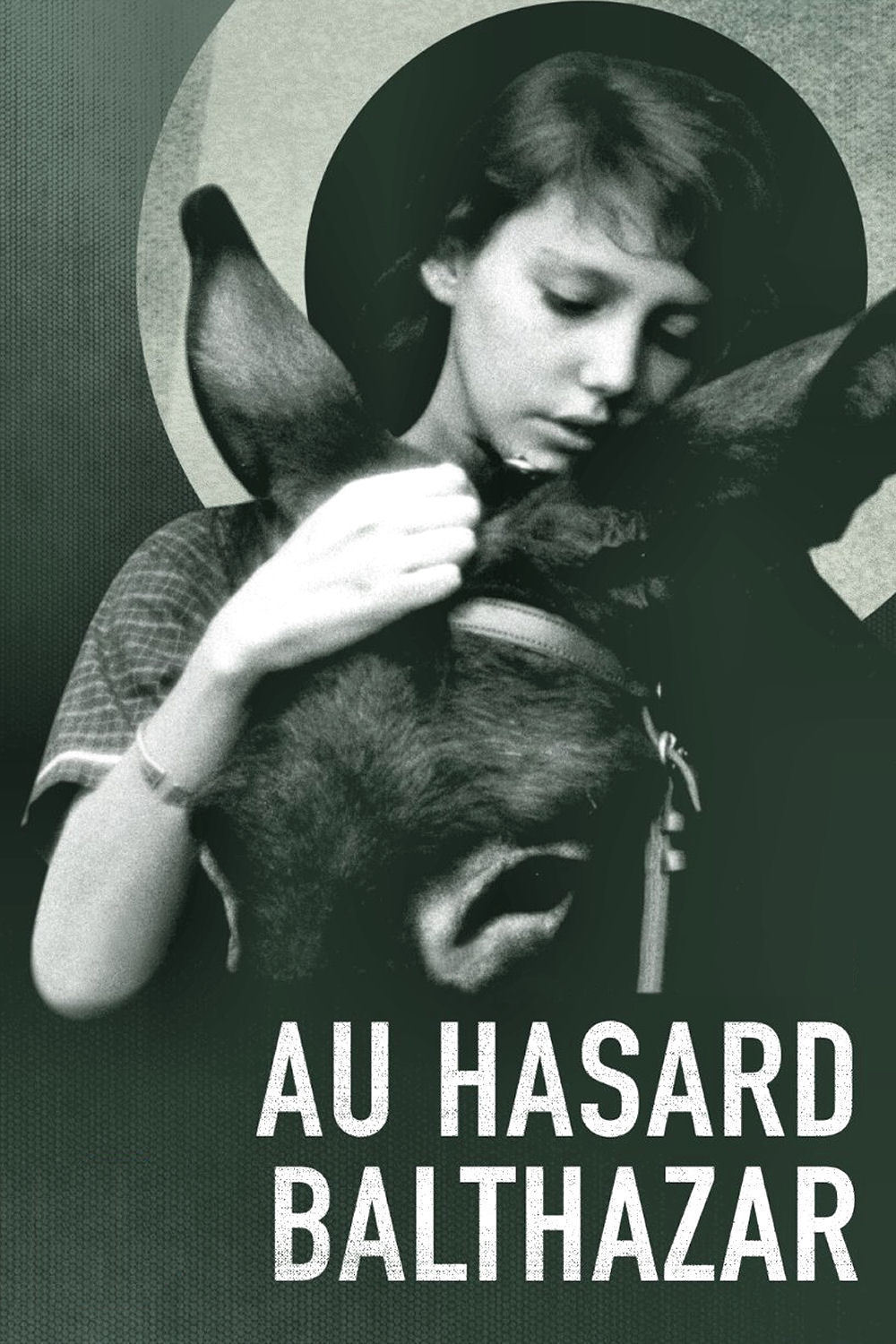
#5 - Au Hasard Balthazar (Robert Bresson, 1966)
And now for my next entry, also from 1966, is a film which Bergman would famously describe as "completely boring." Believe it or not, on this one I actually tend to be in the camp of an artist I sometimes take issue with, Jean-Luc Godard, who said, "Everyone who sees this film will be absolutely astonished... because this film really is the world in an hour and a half." The late Donald Ritchie compared Bresson to the cinematic equivalent of a litmus test when taking note of the varying reactions of he and his friends to the director's pictures. Now, while I can hardly say the same, for when I pitch Au Hasard Balthazar to my friends as this wonderfully beautiful film with a donkey as the main character, I can imagine some of them are probably like, "Okay, there's Callum with one of his 'out-there' suggestions again..." However, I cannot recommend this picture any more than I am about to. Along with the previously mentioned Audition, it is one of two films in this top ten list that I can only watch intermittently, because by the end I am reduced to a complete wreck. No film I have ever seen can conjure such up floods of tears. I won't get into plot details as to why (though of course that is a large part of it), but instead I will elucidate, or at least attempt to give a semblance of an impression of the feeling Au Hasard Balthazar triggers within me. It's as much about the way the story unfolds as the story itself. Exquisite in it's simplicity, this is not traditional storytelling in the classical sense associated with cinema, but more along the lines of a parable, an allegory, a fairy tale, in stripping something a narrative down to it's bare essentials. This is myth as truth, presented through the omniscient, omnipresent saint/Christ-like figure of the donkey Balthazar as he observes and participates in the lives of his various owners, most specifically Marie, played with understated brilliance by Anne Wiazemsky. Perhaps part of the reason I have stepped back a little from regular criticism is because I have in later years preferred to avoid over-thinking, turning everything into an intellectual exercise. The longer I live, the more I lean towards a sort of purity when it comes to feeling, experience and emotion. Not that Balthazar is lacking in content, far from it. It quite clearly has a lot to say about spirituality and faith, struggle, strife and suffering, and as they pertain to life itself. It's just that something like this speaks to my soul, the very heart of me, and I think that is something beyond words or a clinical exercise in critique. It demands a different sort of approach, and I find myself favouring this kind of asceticism, in life and in art. I think what Bresson does here is it's prime example in cinema. Balthazar is so minimalist in every aspect of it's composition, from the naturalistic performances by a largely non-professional cast, to the technical aspects such as the cinematography and editing, and the sparse use of dialogue and music, that the effect of it's impact is almost startling. We are so saturated with showy acting, glory shots, moments of bravado in mainstream movies, obsessed with their own brilliance, vanity and grandiosity, that to see something like this is positively refreshing. But this is not to say it stands as a contrast, a mere juxtaposition to everything else. Au Hasard Balthazar is a distilled essence of life itself, condensed and compressed, like a message in a bottle, into a ninety-minute picture.
#4 - Withnail and I (Bruce Robinson, 1987)
Here we venture off into different territory. Don't excuse the bold statement I am about to make, because I certainly won't: Withnail and I is the greatest comedy ever made. Now, while that may be so, and, yes, I have more than something of a soft spot for this particular entry, it is above the status of base indulgence, for with great reflection I do believe that Withnail and I stands comfortably head-and-shoulders alongside any of the greatest films ever made. I don't need to say that in order to make it true: I just know it to be so. I think I saw the film, as with many over the years, at a way too young age, probably about eleven or twelve or something silly like that, and although I didn't think as highly as I do of it now, I always thought it was a rather unusual little film. It was only as a teenager and as an adult I grew to appreciate it's brilliance. Bruce Robinson, writing and directing a story based upon his own personal experiences, takes us, in the guise of the title characters, through the ribaldrous escapades and adventures of two unemployed actors in September of 1969. Wonderfully played by Richard E. Grant and Paul McGann, the two serve as a superlative example of a yin-ying, buddy dynamic, each representing different aspects, wholly unique parts and perspectives on what is going on, the trials and tribulations, often self-inflicted, of their situation, and the chemistry they share, bouncing off one another in their tete-a-tetes, is simply unmatched. The very strange world of these two down-and-outers in London, seeking to get away from the insanity of the big city and the various vagabonds who populate it, escaping to the country for recuperative refuge and revitalisation, only to be surrounded by a cast of equally outrageous individuals, is nothing short of absolute hilarity. It is for pictures like Withnail and I that the term 'cult film' was invented. Everything, right down to the score by David Dundas and Rick Wentworth just screams eccentricity. However, by no means does this venture into the territory of quirk, that dangerous trend of being offbeat for offbeat sake, attempting to patch over an absence with the bizarre, as I feel a number of certain people have attempted to do with their works in the years since. The reason that Withnail and I works is because although it is a movie of an odd disposition on the surface, there is a substance beneath it all, an element of truth speaks behind everything. Maybe it is because I have been in many similar such silly situations, got up to the same kind of antics, particularly where alcohol and money is concerned, the struggles of the artist, or just, quite simply, what it means to live. Not only is it in many ways a work of kitchen-sink social realism, there is a plain and simple honesty to it, exhibited in particular by writer-director Robinson and his two leads Grant and McGann, that just hits home hard and never fails to touch my heart every single time I watch it. That is when I'm not laughing, or, indeed, sometimes when I'm in the middle of laughing, and I laugh a lot, probably more so than I do at any other film. It is endlessly quotable, so many moments and incidents occurring which sound like the kind of story you would tell down at the pub with your mates, people like Ralph Brown's mysteriously insightful and philosophical drug dealer Danny and Richard Griffiths terrifying lecherous Uncle Monty (for my money, one of the funniest characters in film history), right down to the smallest of parts, that stick out in your memory. Earlier on I talked about accessibility, and this is one of those films. I have seen it in just about every conceivable situation; drunk, stone-cold sober, horizontal and hungover, alert and wide awake, on holiday and at home, lying in bed on my iPod or a big screen, with friends and family. Even my mother, bless her, the single most notoriously hard person to gauge a picture for, the harshest and fiercest critic of the movies I have ever seen, loves Withnail and I. This is autobiographical art and low-budget filmmaking at it's finest.
#3 - Raging Bull (Martin Scorsese, 1980)
I have alluded in the past for my love of Raging Bull. Last year, I wrote a piece on Martin Scorsese with his latest fictional feature, The Irishman, as it's basis, and in that article I declared Scorsese as "America's greatest filmmaker," something I firmly believe in. As a filmmaker in the United States, he is without parallel in terms of the consistent standard of excellence in artistry. However, much as I can appreciate the picturefor it's supreme technical achievements (the immaculate cutting of Thelma Schoonmaker's editing, the beautiful framing of Michael Chapman's black-and-white photography, the extraordinary sound editing by Frank Warner) and as a sum greater than the product of all it's parts, my journey with Raging Bull is a very personal one. I first saw the movie when I was way too young to fully appreciate it for what it was. I just don't think I got it. Later, I became enamoured with Scorsese, in particular Taxi Driver, which was my favourite of the director's work for a long time and still holds a place of great meaning and significance in my heart. However, in university I rediscovered Raging Bull in a number of different ways. It was being played as one of the core pieces for a module (I believe it was Film and Sound, but it could have easily been Music in Film or Hollywood), and indeed it would also crop it's head up and become my selected question during my seated/timed examination, but I had also been in the process of creating a wholly different relationship with the film. You see, without going into things in any great detail because that's a story for another day, a number of incidents had occurred in my life that were fairly 'shaping,' shall we say, and at the time I also was dealing with different issues for which I felt the need to attend counselling. One of the people to whom I am grateful for helping me once I asked me in one of our sessions, "If you could name a movie that you see as representative of your life, what would it be?" I couldn't furnish or provide an answer on the spot, not only because my contentiousness instinctively railed against what I probably felt was a poxy line of questioning, but because I didn't have an answer to provide, the ability to translate cohesively and equate something to the emotions I was dealing with. However, I had recently been developing a bit of a fixation with Raging Bull. I had seen it at least twice before and it didn't click, but all of a sudden around this time I picked it up again, and it was like a flip switched, a lightbulb went off into my head. Maybe it was the supreme commitment of Robert De Niro's performance as Jake La Motta, perhaps the greatest in all the history of screen acting, and those of his supporting cast, specifically Joe Pesci and Cathy Moriarty. Maybe it was the honesty and realism of the screenplay by Paul Schrader and Mardik Martin. Maybe it was the mastery of the craft by director Scorsese, or even, quite simply, the stirring music of Mascagni. Regardless, a chord was struck. I only ever watch a movie several times in quick succession in one of two scenarios: one, if I develop a fixation, and secondly, if I think the work is a masterpiece. Raging Bull ticked both of those boxes, so when I returned for another session some time later, I realised I had an answer to the counsellor's question. The story presented onscreen of Jake La Motta, this animalistic brute of a man on a self-destructive path of obsessive rage who threatens to tear apart his life and those of everyone around him, given my issues with angst, anxiety and anger management, was something I could relate to. It's not necessarily pleasant, but it's the truth, and through truth we come to sympathise, empathise with this churl, who, although we cannot condone his behaviour, actions or the mentality behind it, we can at least come to understand it. Maybe it's the former Catholic and reforming spiritualist in me, but I can relate to how Scorsese goes about this business. There is a sense of timelessness, modern myth-making in the most singular, even dare I say, biblical sense, through the absolute commitment of De Niro's lead performance, that elevates this as a work of art. I cannot say enough good things about Raging Bull. I admire it more and more every time I see it, but on this occasion I have decided to furnish how I praise this picture with a bit of my own story. I hope you can excuse my mild indulgence. Who knows, in ten years time it might well be my favourite film...
#2 - Aguirre, the Wrath of God (Werner Herzog, 1972)
As I mentioned earlier, I do have something of a fondness and leaning towards the art from certain countries, and I think it should be said that I am an outright Germanophile. In particular, the period in which this film was made, though under the fog of the Cold War, the-then divided Berlin between East and West, would see a cultural renaissance in Germany, particularly in the fields of cinema and music. At the forefront of this New German Cinema, as it has been referred to, were filmmakers such as Wim Wenders, Volker Schlöndorff, Margarethe von Trotta and the great enfant terrible, Rainer Werner Fassbinder. However talented those artists may be, while those filmmakers were establishing themselves back home in the streets, concerned themselves in their works with the sights and sounds of the city, their contemporary Werner Herzog was running around the Peruvian rainforest along the Amazon River with a crew and a band of natives shooting on a shoestring. I mean, people talk about troubled productions in the history of filmmaking; this is on a whole other level of legendary, for the circumstances of it's coming to be are incredible. I'm not going to furnish with some of these stories, but you should look them up and check them out. It really is a wonder that so many of Herzog's productions were ever able to be made, much less turn out to be the masterpieces that they are, and Aguirre is the prime example of this singular aesthetic. My first encounter with Herzog was as a teenager when, delirious with a fever for a week in one of my rare sicknesses (which, in hindsight, is probably not a bad way to experience Herzog's films), I managed to get through eleven of his films across two Anchor Bay DVD box-sets. Although there were many great films among them, Aguirre is undoubtedly the one that has always stood out for me the most. Right from the get-go, with that extraordinary opening sequence of the party of Spanish conquistadors and their slaves descending from the Andes, down from from the heavens and into hell in search of the mythical El Dorado, the scene is silent but for the score by Florian Fricke's band Popul Vuh, a synthesised chorus of disembodied voices played on a choir organ, the otherworldly tone and the nature of the piece is firmly established. While ostensibly pertaining to be a historical period piece and existing in a semblance of reality, Aguirre belongs to a whole other realm altogether as we fall into a strange and surreal dreamlike haze of a collective madness. There are so many moments within the film that defy traditional logic and acceptability, and yet within these particular confines are wholly acceptable, make perfect sense. Only the titular Aguirre, played with singular menace and sublime tyranny by Klaus Kinski, stands tall as our guide, indeed thrives in this guise, in a performance every bit as hypnotic as it is terrifying. A precursor to the kinds of themes later explored by Francis Ford Coppola in his 1979 war film Apocalypse Now, Aguirre, the Wrath of God continues to stand and shoulders above anything that followed in it's footsteps. Haunting and hallucinatory, while the film has much to say about the perils of colonialism, the pursuit of wealth, glory and megalomania, it has the wonderful dexterity of being both a work of epic art and guerilla filmmaking, but if anything the thing it most resembles is a fever dream. It is a throbbing, pulsating, gelatinous membrane that could be anything and everything, yet is very much it's own thing, the work of a supreme artist, and it begs to be seen.
#1 - The Terminator (James Cameron, 1984)
There, I said it, although I think I've said it in many different ways and numerous forms over the years. However, this might well be the first time I have hit the nail on the head in the definitive sense, so I feel that such an occasion deserves a bit more gravitas in bringing things round to this particular declaration, as I have been making a few during the course of writing this article: The Terminator is greatest film of all time. I could elaborate to some degree on all of the various qualities of the picture, which I think I will to a small extent, but in order to fully establish what this film means to me, it is best that I speak something of the storied, personal history I have with it instead. When I was a teenager, I was always beating on about A Clockwork Orange, and I do believe that I thought it was my favourite film in that particular present. As time went on though, I kept coming back to where, in many ways, it all started for me with The Terminator. I was first introduced to this world, like many people, through the sequel, Terminator 2: Judgment Day, which I saw on television when it was first broadcast back in the mid-nineties with my parents covering my eyes at the appropriate moments (interestingly, the version that ended up on BBC One on September 3, 1994, which I think was the one I saw, was a wholly unique cut based upon the 1993 Special Edition released on Laserdisc and VHS, not the theatrical cut, featuring the Kyle Reese scene but with edits made for violence and swearing, presumably by the Beeb themselves). Being a child who had until that stage only been exposed to Disney and similar kids fare, I was completely hooked by this thing that was wholly new to me, but my folks were always pretty attentive in trying to protect and not overexpose me to such stuff. That didn't stop me of course from taking advantage of seeing everything unsupervised at a later stage on the VCR, as much of the film had been recorded on the tape. I would later learn how to master all facets of this mysterious device. Similar recordings of broadcasts would be made over the years, left overnight to go until the tape ran out (my personal history with VHS, to this day still my favourite format of home video, is another article worth writing some day, especially as I now have one up and running again!), and so I had the privilege of seeing a lot of movies I shouldn't have. At the time I was especially enamoured with action movies featuring musclebound heroes, but was way too young to purchase them legally or receive permission to watch from my parents. However, I was far too industrious to be denied, so I just had to play the waiting game with the TV guide magazines which I devoured every week, and this was more than likely how I first came across The Terminator a number of years later. My conversion of preference was not instantaneous, but although I still leaned more towards the action-oriented blockbuster sequel, I remember being struck by the unique tonal quality of the original. There was just something strange about it, and really when I think about it in that sense today it still seems strange. The Terminator is this weird, hybrid beast of a picture: on the one hand, it is a dirty, gritty, hard-hitting urban B-movie in which the city at night is very much a character in it's own right, and on another, appropriate given the concept's origin in writer-director James Cameron's own dreams, it like something out of a nightmare. From a genre standpoint, it is pure science-fiction, yet it is a road/chase film full of action and the tenets of slasher/horror movies, and stylistically, while quite clearly a low-budget picture and maybe the ultimate in guerilla aesthetics, it also harkens towards Cameron's future in massively scaled big-budget productions. For all of it's relative compactness and compressed qualities, The Terminator is a movie of big ideas and themes, with a well-developed story, an internal universe and world, that reaches over and above, breaking out of genre-trash confines. There are so many different elements and components, lines and strands I see in this picture, that to lay it all out would be akin to a grid, surrounding a convergence point, the Tech Noir scene. The paths of the three principal characters, Linda Hamilton's Sarah Connor, Michael Biehn's Kyle Reese and Arnold Schwarzenegger's Terminator, all come together. It's an exquisite and genius piece of virtuoso and ingenuity. In a foreshadowing of Reese's later description to Sarah of the post-war future apocalypse from which he has come being the consequence of "one possible future," in the nightclub, Sarah knocks a bottle of water to the floor, and in bending down to pick it up, unwittingly avoids the attention of the tracking Terminator. I just love the idea that the whole of human history from this point is dictated by chance and happenstance. At this stage in the slow-motion shot, the interjection of Brad Fiedel's score, the metallic heartbeat of the machine, begins to play over the top of Tahnee Cain's Burning In The Third Degree, eventually getting swallowed up as all the key players slowly but surely become aware of each other's presences. Bound by fate, the tension builds and builds and builds in a silent scream until the gunshots cry out. It's a largely wordless scene which does everything that a movie should and the prime example of doing what only the medium of cinema is able to. I realise I have gotten this far without actually saying anything much about the component parts of the film that make it up, and indeed, for a personal history, I've jumped ahead about two decades in time. Then again, I've been making those sorts of leaps a lot of late, having become rather interested in certain ideas surrounding the non-linearity of time, malleability of memory, paradoxes, ripple effects in the fabric, dreams and alternative/parallel universes. I digress, but I suppose it makes sense, given their importance in The Terminator. The long story short between then and now is that the film grew on me, super-ceding the status of it's successor in my eyes, and later that of A Clockwork Orange when I realised it truly was my favourite film of all time. I developed one of my obsessions, picking it apart piece by piece, putting it back together again, and it everything always fits rather well. To this day, although it is less so of late, as with everything, given my dedication to my own studies, I still see the film at least three or four times a year, and I can safely say I have probably seen it well over a hundred times. James Cameron, although going onto make many more great films, even masterpieces, never again returned to this sort of aesthetic, and so it is a wholly singular and unique slice of cinematic history. As far as writing about it, if you'll excuse the expression, I've probably only hit the tip of the iceberg. It is pure kinetic storytelling with a continuous momentum that just never stops. For me, it hits all of my key points in every single way and is the complete synthesis of everything great art should be.
In Conclusion
When I wrote of The Terminator, I mentioned the "malleability of memory," and I think that is worthy of note because, not only does that have something to do with the thoughts you formulate, it also plays into how you relate to art, and life, as an observer, and the relationship between objectivity and subjectivity. No matter how much you try to be objective about something, and, at risk of sound egotistical or delusional, I think I've got a pretty hang of it now, the way in which we view things is inherently subjective. We are reactive creatures who cannot help but be moved, touched by the things we experience. I've learned that the influence of time cannot be ignored. If I had have done this list ten years ago, it would have looked very different (at least half the entries would not have made the list, for one thing), and the same could perhaps be said if I am to do it again in ten years time. I know for a fact that my opinions and perspectives have changed. The way I look at things as a human being is different to how I did then, and there's no reason why the same might not happen again in the future. As such, in this case, these things, lists and such, although I may be able to say objectively are representative of my views, here and now, subjectively it stands to reason that they are only indicative of the person I am now at this given stage in my life. Although, for all intents and purposes, it is just a stupid list and a bit of indulgence, these sorts of things fascinate me. It's probably the reason I dedicate myself mostly to my own work, largely abandoning critical analysis in favour of my own explorations as an artist, than I do that of other people now. Still, I've had a lot of fun with this, and I hope that you have had a little too.